
Brooks and Marcus on Iran becoming a 'forever war'
Clip: 7/24/2026 | 10m 13sVideo has Closed Captions
Brooks and Marcus on the Iran conflict becoming a 'forever war'
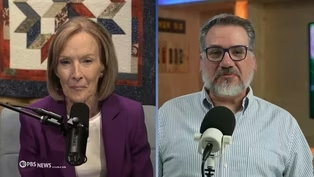
David Brooks of The Atlantic and Ruth Marcus of The New Yorker join Amna Nawaz to discuss the week in politics, including the economic and human toll of the Iran war, the U.S.-Saudi nuclear energy deal and Trump-allied election deniers winning GOP primaries.
Problems playing video? | Closed Captioning Feedback
Problems playing video? | Closed Captioning Feedback
Major corporate funding for the PBS News Hour is provided by BDO, BNSF, Consumer Cellular, American Cruise Lines, and Raymond James. Funding for the PBS NewsHour Weekend is provided by...
Brooks and Marcus on Iran becoming a 'forever war'
Clip: 7/24/2026 | 10m 13sVideo has Closed Captions
David Brooks of The Atlantic and Ruth Marcus of The New Yorker join Amna Nawaz to discuss the week in politics, including the economic and human toll of the Iran war, the U.S.-Saudi nuclear energy deal and Trump-allied election deniers winning GOP primaries.
Problems playing video? | Closed Captioning Feedback
Where to Watch PBS News Hour
PBS News Hour is available to stream on pbs.org and the PBS app.
Providing Support for PBS.org
Learn Moreabout PBS online sponsorshipAMNA NAWAZ: Now, to discuss the economic and human toll of the Iran war, elections here at home, and more, we turn to Brooks and Marcus.
That is "The Atlantic"'s David Brooks and Ruth Marcus of "The New Yorker."
Jonathan Capehart is away.
Good to see you both.
RUTH MARCUS, "The New Yorker": Hi.
DAVID BROOKS: Hello.
AMNA NAWAZ: Let's start with the Iran war and how it's resonating here at home.
As you both know, gas prices now, according to AAA, are at $4.11 a gallon as the national average.
And while we have all seen Democratic opposition to the war, here's what a new Politico poll tells us, that some 37 percent of self-described MAGA voters think the war should continue even if prices go up.
That is down from 50 percent in May.
As you both well know, the human toll is also rising.
We saw four service members killed in just the last week.
That's on top of 14 others the Pentagon previously reported.
And right before he attended the dignified transfer of those four, the president shared this post, comparing the death toll of this war to others and writing: "These are the facts.
Report them."
So, David, at this point, what costs are Americans and supporters of the president willing to tolerate here?
DAVID BROOKS: Yes, I try not to make predictions because I'm not a total idiot, but I do think -- it would not surprise me if this war were still going on in January of 2029, when Trump leaves office.
AMNA NAWAZ: Really?
DAVID BROOKS: I just don't think he cares.
I don't think he cares about the midterms.
I don't think he cares about gas prices.
I think he cares about legacy.
And he wants to see himself as a man who remade the Middle East.
And he would not be the first U.S.
president who had that illusion.
And he talks about -- there's scuttlebutt today that the Cabinet is gathering to think maybe we should do a big massive expansion of the war.
I don't think we have the material to do that, like the missiles, all that kind of stuff.
So it would not surprise me if this dragged on with this, what we have been seeing the last couple months, the missile, missile, missile exchanges, small exchanges, this, that, talk, non-talk.
And that could go on forever.
And MAGA came into office saying we will have no more forever wars.
Well, here we are.
RUTH MARCUS: I have that written down right here.
RUTH MARCUS: He's gotten us into the kind of forever war that he's pledged that he was going to avoid.
And it's not even a forever war.
It's like a Groundhog Day war, because we're in this same cycle of threats and then retrenchment and threats and retrenchment, and we have an MOU and we don't have it.
I don't actually see how this could continue, even if he wanted it to, through January of 2029.
Is that what we have to get to?
DAVID BROOKS: That's my guess.
RUTH MARCUS: For this reason.
Exactly what you said, Amna.
People are fed up.
MAGA is fed up.
I filled up the other day at the pump, and it is painful.
And it's painful for a lot of people.
And I just don't think, even if he wants to, even if he doesn't care about the midterms, the midterms care about him.
And he -- even if he wants to persist, Congress at some point -- the first rule of politics is self-preservation.
They have not shown a willingness to stand up to him and defund the war yet.
But that -- if we are slinking, whatever, towards 2029, I think we will see that at some point, because this is intolerable for people.
It's intolerable for the global economy as well.
AMNA NAWAZ: You use the word painful.
We should underscore, most painful for the families who've lost someone in this war.
RUTH MARCUS: Yes.
AMNA NAWAZ: While we're talking about the region because it's already undeniably rippled across the region, this is the same week the Trump administration signed a nuclear deal with Saudi Arabia that lets U.S.
companies supply nuclear reactors and fuel for a nuclear energy program in the kingdom.
The president says that this deal bars them from uranium enrichment for weapons purposes.
He also said yesterday the deal hinges on Saudi Arabia essentially normalizing relations with Israel, which Saudi leaders have said they will not do unless there is a path for a Palestinian state.
David, we have talked about this before.
But the president announces a deal and then throws a wrench in it?
What what's going on here?
DAVID BROOKS: Well, he likes doing deals with the Saudis.
He thinks he can make money for American corporations.
And this little wrinkle is probably going to not make it not happen unless Trump drops the wrinkle.
The big picture here is that, as U.S.
nuclear umbrella withdraws from the world, as America begins to play a smaller role in the world, all sorts of countries around the world are thinking, holy cow, we need nuclear weapons.
The Saudis are thinking of that.
The Japanese are thinking about that, of all nations.
The Poles are thinking about that.
RUTH MARCUS: Well, they would know.
DAVID BROOKS: They would know, and they have suffered.
And they have -- so you have -- you could see a dozen, 15 countries not getting nuclear weapons, but considering it, because the U.S.
umbrella is no longer there.
So if you wonder what the effect of U.S.
power is, whether it's a force of stability or not, here's your sign.
It is a force of stability, and when you withdraw that force, the world gets a lot more dangerous right quick.
AMNA NAWAZ: I mean, that's a major reworking of the global security landscape, Ruth.
RUTH MARCUS: And that's precisely why this is a bad idea, this nuclear deal is a bad idea, because more proliferation is -- and the risk of proliferation is worse than nonproliferation.
And we are mired in this situation with Iran because we helped them get nuclear technology when the shah was in power.
How did that work out for us?
So Trump -- and it was a bad idea, by the way, when the Biden administration was talking about doing this, though it at least had the prospect of getting the benefit of Israeli recognition.
Here, Trump, he's so erratic.
He knows that Saudi Arabia can't at the last minute agree to the Israel recognition, and he throws it in anyway, like he's still negotiating leasing the top two floors of Trump Tower or something, and thinks he can wring something else out of people at the last minute.
It's not going to work, and I think we should probably be semi-thankful for that.
AMNA NAWAZ: Well, while I have you, I want to ask you about some political takeaways from election results we saw this week, because, back here at home, we saw the crucial swing state of Arizona hold their primary elections.
On the Republican side in particular, we saw three prominent election deniers win their races, these primary races, for governor, for secretary of state, and for attorney general.
David, when you look at these results, what stands out to you?
What does it say to you about the party or just about Arizona?
DAVID BROOKS: Yes, I once interviewed a guy who got the nomination of a major party, and they said, what did you learn when you get the nomination?
And he said, I learned we have no party.
We call it a party, but there's nothing in -- it's like a box with nothing in there.
Donald Trump has actually filled in the box.
Some of it is just the Trump persona.
But he actually has a structure.
He has an organization around the country.
They control the local activist community.
And, therefore, they win these primary elections at least, because they actually have a party.
On the Democratic side, it's not clear they have a party yet, because you look at the candidates that have been championed by the Washington Democrats, they have a pretty poor batting average.
They won one out of two in Arizona, let alone what happened in New York and other places.
And so the Democrats don't have a party.
And Trump has a party.
It just means it involves nominating a lot of election deniers, but they do have a structure.
And I wonder whether it will last after Trump, whether MAGA is a thing after Trump.
And I think it's not just the Trump personality.
I think they actually have cadres.
They have a structure.
They have believers.
So it works the way a party used to work, frankly.
RUTH MARCUS: So I think you're a lot more bullish on the future of the Republican Party than you should be.
And I don't think this is just wishful thinking, for this reason.
If you're looking at this election in Arizona through the lens of Donald Trump, who doesn't care about the midterms, but kind of cares about the midterms, you're going to feel pretty good about this.
He asserted his power.
He has, I agree with you, shaped the party and bent it to his will.
But here's the situation.
In Arizona, there are 313,000 more Republican voters than Democratic voters.
Yet there are two Democratic senators from Arizona and the top three statewide officials in Arizona, including the governor, are Democrats.
Why is that?
Because Republicans led by Trump are hiring, nominating precisely the wrong kind of people.
So, bully for them that they got their election deniers in the primaries.
That's not that hard.
How are they going -- you see the nominee, Andy Biggs, for governor trying to remake himself, but let's be serious.
He is the former head of the House Freedom Caucus and a leading election denier.
He can deny that now or try to soft-play that now.
But this is going to be a harder road for Republicans to regain power in the state than it would have been if they had taken a less Trumpy, more sensible approach.
AMNA NAWAZ: Just a quick minute left here, but I want to get both of you.
Just more than a week after the president delivered a prime-time address and blamed China for election interference in 2020, every time he is asked about it, there do not seem to be any repercussions for that alleged interference.
David, why not?
DAVID BROOKS: Because he's the present tense man.
Everything is happening at that moment, and what happened yesterday doesn't matter.
What happens tomorrow doesn't matter.
He's doing what's happening at this moment.
And in this case, I happen to be glad, because the China charges were bogus, and we need to have a relationship with China.
And so he's letting us have a relationship with China and not letting bogus charges get in the way.
So I'm glad he's -- he forgot what happened yesterday.
AMNA NAWAZ: Ruth.
RUTH MARCUS: This was never about calling China to account or punishing it or cracking down on it.
This was just about convincing the voters, if he is to lose in November, that they shouldn't trust that.
It's not about China.
It's about the United States and about diminishing confidence in our election system.
AMNA NAWAZ: And, meanwhile, President Xi will be visiting the White House in September.
Ruth Marcus, David Brooks, great to see you both.
Thank you so much.
RUTH MARCUS: Thank you.
 New
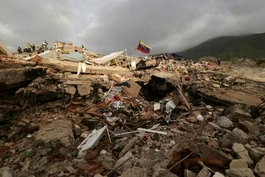
NewAid worker describes crisis in Venezuela after earthquakes
Video has Closed Captions
Aid worker describes crisis in Venezuela, one month after devastating earthquakes (6m 46s)
 New
NewEye prosthetics become canvases for self-expression
Video has Closed Captions
Ocular artistry: Eye prosthetics become canvases for self-expression (8m 18s)
 New
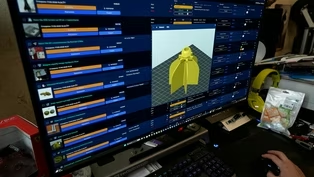
NewHow volunteers with 3D printers make weapons for Ukraine
Video has Closed Captions
How volunteers with 3D printers make weapons for Ukraine (8m 33s)
 New
NewJason Epperson on the history found at national parks
Video has Closed Captions
Jason Epperson on the history found at national parks (3m 27s)
 New
NewNews Wrap: CDC reports more measles cases so far this year
Video has Closed Captions
News Wrap: CDC reports more measles cases so far this year than in all of 2025 (6m 48s)
 New
NewTrump sets new tariffs, covering nearly all U.S. imports
Video has Closed Captions
Trump sets new tariffs on trading partners, covering nearly all U.S. imports (7m 51s)
Providing Support for PBS.org
Learn Moreabout PBS online sponsorship New Episode
- News and Public Affairs

Today's top journalists discuss Washington's current political events and public affairs.

- News and Public Affairs

FRONTLINE is investigative journalism that questions, explains and changes our world.

 New Episode
 New Episode
 New Episode
 New Episode
 New Episode
 New Episode

 New Episode
 New Episode
Support for PBS provided by:
Major corporate funding for the PBS News Hour is provided by BDO, BNSF, Consumer Cellular, American Cruise Lines, and Raymond James. Funding for the PBS NewsHour Weekend is provided by...