
David Byrne
Season 13 Episode 9 | 26m 46sVideo has Closed Captions
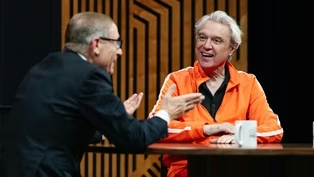
Legendary performer David Byrne discusses his album "Who Is The Sky?"
Legendary singer-songwriter, visual artist, writer and filmmaker, David Byrne, discusses his career as the founding member of the Talking Heads and his album "Who Is The Sky?"
Problems playing video? | Closed Captioning Feedback
Problems playing video? | Closed Captioning Feedback
Overheard with Evan Smith is a local public television program presented by Austin PBS
Support for Overheard with Evan Smith is provided by: HillCo Partners, Claire & Carl Stuart, Christine & Philip Dial, Eller Group, Diane Land & Steve Adler, and Karey & Chris...
David Byrne
Season 13 Episode 9 | 26m 46sVideo has Closed Captions
Legendary singer-songwriter, visual artist, writer and filmmaker, David Byrne, discusses his career as the founding member of the Talking Heads and his album "Who Is The Sky?"
Problems playing video? | Closed Captioning Feedback
How to Watch Overheard with Evan Smith
Overheard with Evan Smith is available to stream on pbs.org and the free PBS App, available on iPhone, Apple TV, Android TV, Android smartphones, Amazon Fire TV, Amazon Fire Tablet, Roku, Samsung Smart TV, and Vizio.
Buy Now
Providing Support for PBS.org
Learn Moreabout PBS online sponsorship- [Narrator] Funding for "Overheard with Evan Smith" comes from Hillco Partners, a Texas government affairs consultancy, Claire and Carl Stuart, Christine and Philip Dial, Eller Group, specializing in crisis management, litigation, and public affairs communication, EllerGroup.com, Diane Land and Steve Adler, and Karey and Chris Oddo.
- I'm Evan Smith.
He's a Rock and Roll Hall of Famer, who is a founding member of one of the greatest bands of all time, The Talking Heads.
His 11th album as a solo artist is "Who Is the Sky?"
He's David Byrne.
This is "Overheard."
A platform and a voice is a powerful thing.
You really turn the conversation around about what leadership should be about.
Are we blowing this?
Are we doing the thing we shouldn't be doing by giving in to the attention junkie?
As an industry, we have an obligation to hold ourselves to the same standards that we hold everybody else.
Two.
This is "Overheard."
(audience applauding) David Byrne, welcome.
Thank you so much for being here.
- Thank you for inviting me.
- Oh, it's absolutely great.
My 22-year-old self is dying right now thinking that I'm sitting right here.
Can we, the record is so terrific.
I really enjoy it.
The biggest compliment I can pay you is it feels like one of your records, right?
It sounds like you, which of course it does.
But it feels authentically like you.
And I wanna know what the story of this record is like.
What were you thinking about when you made it?
- Whoa.
I tried to write during the pandemic.
- [Evan] Yeah.
- And couldn't really write songs.
I did a lot of drawings.
I did other things.
- Like the rest of us, you were stuck inside.
- I was stuck inside.
I could have written songs inside.
I have a spare bedroom that's my music room.
And I wrote some words down and some ideas, but no songs.
I wrote one song, it was called "Six Feet Away."
It was a... (audience laughing) - You were literally writing during the pandemic.
Look at that.
- Yes.
She had PerElle in her purse, yeah.
And I sent it to the comedian, John Mulaney, and he said, "I like the PerElle line, but the rest..." - Don't do it.
Lost to history now, right?
That's it.
Yeah.
Yeah.
So, but the but creative process for this record ultimately goes back that far.
- Yes.
So as the pandemic waned, then those kind of creative juices started flowing, and some of the, one song at least refers pretty much to the pandemic.
There's a song called "My Apartment is My Friend."
And thank God it was, yeah.
Yeah.
I was lucky.
Maybe not the same here in Austin, where a lot of people has homes or places with yards or whatever.
In New York, people have little tiny apartments.
And mine is a little bit bigger, has a little bit of an outdoor terrace, but for people who were stuck in a little tiny apartment, woo, it was tough.
It's tough for them.
Anyway.
Yeah, so then I started writing things, writing a lot of words, you know, potential lyrics.
I'll just start writing.
- This is your normal process.
- Yeah, it's, yeah, whatever comes to mind.
Sometimes it'll start with a title.
Like, I had an idea, I thought, "Oh, 'I Met the Buddha at a Downtown Party.'"
And that was the title.
And I thought, "So what happens next?"
- Right.
Exactly.
- The song kind of writes itself.
You fill in the rest, yeah.
What was he doing?
What did he say?
- Yeah.
- Did you have a conversation?
What did you, what's the takeaway?
What did you get outta this?
Yeah.
- Amazing.
The title, "Who Is the Sky?"
I love this story.
This is a mistaken voice to text.
Is that right?
- Yes.
Yes.
My wife uses the voice to text a lot, and it gets garbled quite often and where I'm going, like, "What's she trying to say here?"
And this is one where obviously she was saying, "Who is this person?"
- Right.
Who is this guy?
- Yeah.
And it came out, it translated it as, "Who is the sky?"
And I go, "Oh, that's..." - That's a title.
- That's kind of metaphysical there.
- Garbled voice to text is very relatable.
I just want to say.
Very relatable.
Excellent.
You are now in the middle of a 68 date tour, is that right?
68 stop tour.
- I haven't counted.
It's a pretty long one.
It's a long one.
- And the thing about you touring is this is not just a concert, like band goes to play a concert.
You've been a visual artist your entire career.
This is a multimedia extravaganza.
There's choreography, there's stuff projected on video screens.
Like this is not an easy thing to do.
- Yeah, yeah.
I set myself a task and said "Well, I have to," I also think to myself, "I can't go backwards from the last one I did."
I have to like, move on from that.
- Well, you know, "American Utopia" in many ways was the perfect thing, but also it set an extraordinarily high bar, did it not?
- Yes.
I have to admit that.
And I thought, "I can't retreat from that.
Now I have to somehow build upon that."
Not just copy it, but take that and say, "Okay, what else can you do?"
So yeah, it becomes a whole thing.
There's elements of theater and obviously a concert and kind of visual stuff.
- Right.
It's a feast.
- I hope.
- It is.
Yeah.
- You're 73.
- Yes, I am.
- For someone younger, the burden of doing this every night for so many nights would be enormous.
I'm always amazed when I see you on television or think about the work you do, your level of energy seems totally no different than it was before.
- Thank you.
- Am I wrong about that?
- Well... - I mean, you biked here.
Let's just talk about that.
- That helps, getting that exercise, - Blood flow.
- Fresh air and aerobic stuff and everything.
Yes.
That helps, that helps.
The concert movie "Stop Making Sense" was released a couple years ago, re-released a couple years ago, and I watched it, and when the new print was made, hadn't seen it in quite a while.
And I'm looking at it and going, "Ooh, there's a couple moves in there" that I thought, "I don't think I could do that."
- Right.
- Other things, yes.
- Yeah.
- But that, there were a few things.
- Well, but you're not, I think the point is on stage, you're not a stationary person.
And that's something that I say respect.
Right?
Like the amount of effort that you have to put in.
- Thank you.
- You're putting on a show for people.
- It's fun, yeah.
I feel like the audience pays good money.
- They do.
- Yeah.
- So you have been making records for 44 years as a solo artist.
I mean, not alone, but like, this is separate and apart from The Talking Heads.
I think the first one was in 1981.
It was "My Life in the Bush of Ghosts" with Brian Eno.
- Yes.
- Right?
That was 1981.
So we're talking about 44 years.
Talking Heads was only around for 16 years.
Like, you're not the guy from The Talking Heads who's now had a career as a solo artist.
You're basically a solo artist who had a little bit of time in a band.
- Well, that's one way of looking at it.
- I mean, the overwhelming majority of your career has been this, not that.
- Yes.
Yes, it has.
But as you said, kind of the first things I did, apart from Talking Heads were more kind of experimental or a theater score, or a movie score or things like that.
I wasn't, definitely was not trying to compete with the band.
- Yeah.
- And then eventually, yeah, eventually I had some things I wanted to do, musical things I wanted to do, and yeah, led me on down a different path.
- Right, I mean now, I think, and also a lot of people still associate you with Talking Heads.
- Yes, I'm aware of that.
- Yes.
(audience laughing) Are you good with that?
- Oh, yeah, yeah, yeah, I'm proud of, really proud of what we did.
- Yeah.
- Yeah.
- Like all these years later, it doesn't bother you to have people make that association?
- No, not at all.
I'm proud of what we did, I, the music and the shows that we did and videos, whatever.
- I can tell you as somebody who still associates you with that band, there's no disrespect to the stuff that you've done since, it's just, holy smokes.
Right?
It's the Holy Smokes reaction I think a lot of people have.
So, I wanna go back to the beginning if that's okay.
So you were born in Scotland, which I had to remind myself, you were born in Scotland, your family moved to Canada, I think under the age of 10, you then moved to the United States, to Maryland.
- Yes.
- So went to school there, you go to RISD, the Rhode Island School of Design in Providence.
Do about a year there, right?
Leave, you go to art school in Baltimore.
Don't finish there.
Leave, go back to Providence.
And that's where you met Chris Frantz, right?
- Chris and his girlfriend at the time, Tina.
- [Evan] Tina.
- This is before there was a Talking Heads.
- Before there was a Talking Heads.
And Chris wanted to put together a band.
So Tina was not in it, but there was other- - There was a band before this band.
- There was a band, yeah, with some other students and various people.
- [Evan] Yeah.
- I was part of that, and I started writing songs for that.
And some of 'em, people kind of liked.
And so I thought, "Huh."
- Maybe there's something to this.
- Maybe there's something to this.
- But that band didn't make, the first band, didn't make- - No, no.
People, yeah they were students, they were whatever, and they went their own way after that.
And then Chris, Tina, oh, I moved to New York at the invitation of a painter friend.
And they followed shortly thereafter.
- So this is like '74.
- Yeah, somewhere around there.
And they moved, and then I think it might have been Chris who said, "Let's start another band."
- So as the saying goes, the name of this band is Talking Heads.
- Yes.
- But why that name?
I've always wondered why that name.
- We tried different names.
We had a, what's called a cold water loft in New York.
Really cheap.
I would make, we would try different band names, and I would make a, put the band name on a piece of cardboard and put it on the bass drum head and go, "Let's see how that looks.
Let's see how we like that."
- Right.
Try it out.
- I think one was called The Dots, and that didn't work.
And we had a friend, another artist from Chicago, and I think he was looking at TV guide, and said, "Oh, there's a movie called 'Talking Heads.'"
And thought, "Oh, that's a good one."
So we tried it and you know, in that we tried, let's live with that for a while, this is not in public, nobody knew.
We thought, "Okay, we'll stick with that one."
- And then eventually... - Yeah.
We liked the fact that it was, came from this some kind of B movie.
And it was like a horror movie or something like that.
But it was also this TV term for, well, what we're doing now.
- Sort of, right, yeah.
- Yeah, kind of.
- Amazing.
So the first time you played in public together, Jerry Harrison was not in the band yet.
He was still in The Modern Lovers, right?
- Right.
It was just a trio.
- So it was 50 years ago was the first time you played out.
It was June of '75.
You opened up for the Ramones at CBGB's.
The most New York thing ever.
I swear to God.
And so you guys come out stage, first song you play is "The Girls Want to Be with the Girls."
Right, this is before there's a record out.
It's like two years before "77" comes out.
Right?
What must that have been like, that scene, that CBGB scene, then, what was that like?
- It was, it hadn't blown up.
So it was just a bar in a really down and out neighborhood.
- Yeah.
- And, the bar owner was smart enough to know that "I'm not gonna get anybody in here unless I offer something other than just cheap beers or something."
So I think it was the Tom Verlaine from the band Television who approached them and said, "We have a band.
We'll play here, and you give us a door, or you give us a door and you can keep the drink money.
We'll bring in customers for you."
Which I did.
And he was friends with Patti Smith as she started playing.
So we were living right around the corner.
We'd see them there and we'd go, "That's where we should go."
So we could write songs and rehearse 'em and thought "That's, when we get enough, we're gonna audition."
So we auditioned in like an afternoon.
And the owner, Hilly, said, "Yeah, we'll put you on, you can open for the Ramones."
Which was, I mean, musically worlds apart, but to be, to their credit, and to the audience's credit at that point, the audience was interested in everything.
I mean, Patti Smith would be reading poetry with Lenny strumming a guitar behind her, and then, yeah, all kinds of things.
Everything was very different and the audience kind of accepted it all.
And it hadn't kind of coalesced into, "Oh, this is a punk sound, or this is that."
So that was kind of great.
We had, I think the audience, oh, it might have been 20 people or whatever at first, but I think Patti Smith's guitarist, Lenny Kaye was in that audience.
And he said, "I really like what you're doing."
And for us, that was like, "Whoa."
- You got the Lenny Kaye approval.
- We got the seal of approval.
And, yeah, for us, this was a guy that had great credibility.
- Yeah, of course.
- So I always remembered that, when a younger musicians or writer, whoever, say, "How do I get started?
How do I get started?"
And I go, "You can start small.
If 20 people like you, their friends might like you.
And their friends, and their friends, and their friends."
Yeah, if that little group in the front in the beginning likes you, likes what you're doing, you're kind of good.
- It's a great lesson for people starting out.
- Yeah.
You can start in a very modest way.
- Right.
I heard Chris say once that the thought of Talking Heads was "We wanna make music that entertains our friends."
Like it was a very simple elemental thing.
I mean, I think that's great, but also, I forget, and now I've had to go back and look this up.
The band was enormously successful, like every one of the records that you made, gold, platinum, or beyond.
- Well, now.
- But I mean, but, but, but, but, but, I mean, maybe it's the case over time, but still those records didn't just sit there, like people loved you.
- Yeah.
- It was a very successful band.
- It grew.
We didn't have like big hits right away.
Some of our compatriots, others did.
Blondie had like huge hits right away.
And it was, for those, for some who became successful quicker than us, we could see that it was tough for them.
It was a lot to learn and a lot to handle.
- But you had a long tail.
And look, I think the Jonathan Demme directed, you referred to "Stop Making Sense," the concert film, greatest concert film of all time.
Right?
Accepted, greatest concert film of all time.
That had the effect of exposing you probably to a wider audience.
- I believe so.
Yes.
Because it's, right, tour's over, people can still see it.
- Yeah, I'm also remembering that when Talking Heads was out among us as a band, this was the era of the music video coming online, like MTV, Talking Heads started in 77, or 75, but first album comes out in 77.
MTV starts in 1981.
And the "Once in a Lifetime" video, which you directed with Toni Basil, is one of the iconic music videos in the history of MTV.
Right?
So that also, I mean, you're a visual artist, like that had to really speak to you, right?
- Exactly, I thought, "Oh!
Now here's a visual outlet, that's also tied to the music.
Maybe I can figure out a way to make something really kind of cheaply, on a budget."
- But look different from everything else.
- But look, yeah, look different than other things.
And this outlet, MTV, is desperate for material.
And, you could give them something and within a week they put it on.
- They just put it on, they didn't care.
Exactly.
- You know?
Yeah.
- Exactly.
Yeah.
- They put it on, they just needed to fill up space.
- Ric Ocasek might phone it in, but you didn't, that's my point.
Right?
Like most of the people in those days who produced that stuff did not put as much artistic time and effort into it.
That's I guess my point.
It really feels like something you would've done.
- Oh, thank you.
- Looking back.
- Yeah.
- So I mentioned 16 years, 75 to 91, the Talking Heads exist as a band.
You have been asked endlessly about the end of the band.
- Oh.
- Is it, after all this time and self-reflection, more than "Bands break up, that's what happens."
Is there more to it, do you think than that?
As you think back on it?
- More as in... Oh, bands have a lifespan.
- Well, I mean, I think that we often wanna associate some kind of drama or narrative to something that just sort of happens all the time, sort of organically, like bands break up.
- Yeah.
I don't think there was a huge drama.
I know that, I mean, there were dramas, but it wasn't about, it didn't stem from a drama.
Yeah, and it sounds like a cliche, but for me, I was really interested in exploring.
- But that's often what happens, right?
- Yes.
- I wanna date other people.
- Okay.
(audience laughing) And so I'm full of admiration for bands that stay together forever and ever and ever.
- Some too long probably.
Right?
- Maybe, maybe.
But, eh.
If they can do it and keep doing interesting things... - You feel good about those three?
About Chris, Tina and Jerry?
- Oh, yeah, yeah, yeah.
- No bad blood.
I mean, everyone keeps coming to you and saying "Reunion!"
Right, the one time I've seen you play together that I can remember since then was the Rock and Roll Hall of Fame induction.
- Yes.
- Where you got back together.
- Yeah.
- Right, yeah.
Right, you got one, apparently one other person saw it.
You know, this is, I looked this up, it is 49 years to the week that Lorne Michaels offered George Harrison a certified check for $3,000 if he would get the Beatles back together.
And I thought, I have a certified check for you, David.
(audience laughing) Is there any chance that you would, do you think in our, I mean, I realize that "Talking Heads: 77" is about to celebrate 50 years.
- Yeah.
Yeah.
- Any chance?
- No, I don't think so.
We coordinate and keep in touch about these re-releases and all that kind of stuff, but no, I mean, I'm kind of busy with what I'm doing.
- You're doing your thing.
Okay, good.
Well you know, a girl can dream, you know, and actually, I'm thinking, boy, it would be amazing to see you guys one more time.
So we have about five minutes left.
I wanna ask you about a couple things.
"American Utopia," which I mentioned earlier.
This was a record, started out as a record, one of your solo records.
It then became a stage production.
And Spike Lee filmed it, and then it was a film of the stage production.
And this came out during the pandemic.
- Yeah, we... What Spike filmed was a Broadway version of the concert.
Which was adjusted for Broadway.
And then we stopped our Broadway run like two weeks before everything shut down.
- Yeah.
- Whew.
- But he had filmed it.
- He had filmed it, luckily he had caught it.
So he worked with his editors and everything like that.
- And so it was released right in the middle of the pandemic when all of us were in our houses going crazy, to be honest with you.
And I watched it like 25 times.
And I swear to God, it saved me, watching it.
That is one of the most extraordinary things I've ever seen.
Do you look back on that experience as somehow different, singular, differentiated from other things you've done?
Because that just seems like all of the elements came together in one thing.
- At the time, yes.
At the time, yes.
And now I have a new production and I feel like, "Oh, now this is building on that."
- Like can you top this?
- Yeah.
Can you top this?
Kinda eh, well, that's not for me to judge, but yeah.
- Can I ask you about "Reasons to be Cheerful"?
- Yeah.
- I am a reader of this nonprofit news organization, nonprofit news guy, talking to nonprofit news guy.
That's this portion of the conversation.
This is, it's stories for tumultuous times.
It's stories of hope.
It's like solutions to problems.
It's not negative, it's not like ridiculously positive, but at the same time you're telling people things that give them reason to be optimistic about the world.
- Yes, this was, I started that before the "American Utopia" project, and I probably, like all of us, we'd get up and read the paper online and get myself all worked up.
And so I started saving stories of people who had found solutions to things, of good things were happening.
And eventually I realized I've got a lot of them.
There's more than I thought.
I started putting 'em in little folders and things like that.
And then eventually (indistinct), "Oh, I think this should be done a little bit more professionally."
- Formally.
- Formally, a little more professionally than just me keeping things on my laptop.
And so I hired people, editors and writers and all that thing.
- So you're a news guy.
- Kind of.
Yes.
At the time I thought of the record and the show, the "American Utopia" record and show, I thought of that as like, under the "Reasons to be Cheerful" umbrella.
I thought this is all part of the same thing.
- Yeah.
- We're showing what's possible, in the same way that the stories that we've put out, are putting out, this is possible.
People have done this, people have found a solution to this.
- Yeah.
Well, it's fascinating.
I encourage people to check it out.
I've enjoyed reading it for some time.
Last last thing before we go, really long "New Yorker" profile of you, the last couple of weeks published, I thought it was so interesting.
I learned a lot.
And the thing that I thought was most interesting was the question to you, "Is there a through line in all of your work?"
And you said it's the attempt to answer these big questions.
Who are we?
What is our purpose here?
It's who is this guy, isn't it?
- Yes!
Yes.
- I mean, in the end, we end where we started.
Like you're still at this age, at this long period into your career, you are still asking the question, "Who is this guy?
What are we doing?"
- Yeah.
I mean, it sounds terrible.
It sounds like you've been doing this all your life, you don't have an answer yet?
- No, no, no.
We're lifelong learners, David.
That's it, right?
But I appreciate the fact that you're willing to say out loud, "We don't have this figured out, and my art is an attempt to figure it out."
- Exactly.
And you find out, you get kind of hints of an answer to certain things here and there.
- Yeah.
Amazing.
All right, well, I mean, I could just sit here across from you for hours, but we are out of time.
David Byrne, thank you.
Congratulations on your success and thank you for being here.
- Thank you for having me.
- It's a pleasure.
(audience cheering) - [Evan] We'd love to have you join us in the studio.
Visit our website at austinpbs.org/overheard to find invitations to interviews, Q&As with our audience and guests, and an archive of past episodes.
- I was kind of socially awkward, so music and performing was a way to, "Here I am.
I have something to say.
I exist."
(cheerful music) "I have trouble having a conversation with you, but I can communicate this way."
- [Narrator] Funding for "Overheard with Evan Smith" comes from Hillco Partners, a Texas government affairs consultancy, Claire and Carl Stuart, Christine and Philip Dial, Eller Group, specializing in crisis management, litigation, and public affairs communication, EllerGroup.com, Diane Land and Steve Adler, and Karey and Chris Oddo.
(bright music)
Video has Closed Captions
Clip: S13 Ep9 | 8m 46s | Legendary performer David Byrne discusses his album "Who Is The Sky?" (8m 46s)
Providing Support for PBS.org
Learn Moreabout PBS online sponsorship
- News and Public Affairs

Top journalists deliver compelling original analysis of the hour's headlines.

- News and Public Affairs

FRONTLINE is investigative journalism that questions, explains and changes our world.












Support for PBS provided by:
Overheard with Evan Smith is a local public television program presented by Austin PBS
Support for Overheard with Evan Smith is provided by: HillCo Partners, Claire & Carl Stuart, Christine & Philip Dial, Eller Group, Diane Land & Steve Adler, and Karey & Chris...