Here and Now
Here & Now for January 23, 2026
Season 2400 Episode 2428 | 26m 47sVideo has Closed Captions
Watch the entire episode of Here & Now for January 23.
Watch the entire episode of Here & Now for January 23.
Problems playing video? | Closed Captioning Feedback
Problems playing video? | Closed Captioning Feedback
Here and Now is a local public television program presented by PBS Wisconsin
Here and Now
Here & Now for January 23, 2026
Season 2400 Episode 2428 | 26m 47sVideo has Closed Captions
Watch the entire episode of Here & Now for January 23.
Problems playing video? | Closed Captioning Feedback
How to Watch Here and Now
Here and Now is available to stream on pbs.org and the free PBS App, available on iPhone, Apple TV, Android TV, Android smartphones, Amazon Fire TV, Amazon Fire Tablet, Roku, Samsung Smart TV, and Vizio.
Providing Support for PBS.org
Learn Moreabout PBS online sponsorship>> The following program is a PBS Wisconsin original production.
>> Wisconsinites braced themselves for the dangerous Arctic chill, while some also brace for the white House to send an influx of Ice agents into the state.
[MUSIC] tonight on "Here& Now".
Community advocates prepare for immigration action in Wisconsin.
Then, following a disappointing football season, the UW chancellor and athletic director discuss their plan of action, and the candidates for governor show their record of working across the aisle.
It's "Here& Now" for January 23rd.
[MUSIC] >> Funding for Here and Now is provided by the Focus Fund for Journalism and Friends of PBS Wisconsin.
>> The surge of Ice and customs and border control enforcement action across the border in Minnesota has resulted in the arrest of more than 3000 people, according to the agencies, which say the operation there will continue.
Will that kind of escalated force come here?
Advocates for immigrants in Wisconsin believe Milwaukee will soon be a target.
That includes Daryl Morin, the national president of Forward Latino.
He joins us from the Milwaukee area.
Thanks very much for being here.
>> Thank you for having me here.
>> So you have said that it's your and others belief that Ice will undertake a widespread operation in Milwaukee.
What information do you have that that's going to happen?
>> Well, yes.
Over the last couple of weeks, there's been a growing consensus at all levels of government here in Wisconsin that pending a dramatic change in priorities, there will be a large scale enforcement action here in the state of Wisconsin.
We're seeing that they have just under 3500 agents up there in Minneapolis.
And daily we see them coming into western Wisconsin probing, detaining individuals, attempting to detain others, etc.
And I think it's the firm belief of many that it's just a matter of time before they come all the way down to southeastern Wisconsin.
>> And what would bring them to southeastern Wisconsin?
>> Well, we know there's a huge population here in southeastern Wisconsin.
Not too many people know this.
Wisconsin are Hispanics are the largest minority population in the state of Wisconsin.
And there's obviously a tremendous population down here in the southeastern part, as well as in rural areas throughout the state, in our farms and our dairies, etc.
So everything we've heard is that there there is sincere interest at the highest levels to come to Wisconsin.
>> Do you think that the extent of what's unfolded in Minneapolis would happen in Milwaukee?
>> Tragically, yes.
As we've been working with our partners and Los Angeles and New Orleans in Charlotte, etc.
we've seen these significant enforcement actions take place.
And most troubling, most concerning about that is that individuals for no probable cause are being detained are being threatened, in some cases being even assaulted.
So it's a tremendous concern not just for our immigrant population, but for Wisconsinites in general.
>> I know that Milwaukee police policy is that they will not detain or arrest an individual solely for a suspected violation of immigration law, and President Trump has dubbed both Madison and Milwaukee sanctuary cities, although that is not an official kind of status.
How does that factor into whether the administration surges in Wisconsin?
>> Well, I think there's a lot of political calculations that are going into that, quite honestly, with regards to law enforcement's response, I tell you, that's those are discussions we're having every day.
We only need to turn on the news to see what is happening in other places.
As I mentioned, to U.S.
citizens and immigrants alike, where their rights are being violated and what we're going to be asking law enforcement to do here is to do their job.
And if they see a resident of Wisconsin being assaulted, being unlawfully detained, we're going to ask them to intervene.
They're here to protect us.
And sadly, we're seeing our federal agents that are supposed to be doing the same, doing the opposite.
So we're concerned.
I will also share this, as I say, with business leaders around the state, farmers, dairy farmers as well.
There's a growing consensus that as a purple state, any kind of large scale operation here in Wisconsin would actually cost more votes than when being a purple state.
We're hoping the administration takes that into account before making the final decision to come here.
>> To your understanding, how prepared are Milwaukee police and city leaders and others should Milwaukee become a powder keg?
>> Well, we've been working with our partners around the state, both in the private sector and our private sector and government sectors.
We've been very pleased that everyone is taking prudent, prudent steps to make sure that the residents and citizenry of Wisconsin will be protected.
So can't go too far into details on that.
But we're grateful for the partnerships we have with many members of law enforcement and government, as well as our private and nonprofit partners.
>> How has the immigration enforcement changed the lives of people and families and communities?
Yvonne lawfully present people?
>> Well, there's tremendous fear.
Once again, it's one thing.
If we were seeing enforcement action truly going after the worst of the worst.
But that's not what's happening here.
We're seeing over 70% of people who are being detained have no criminal record.
We're seeing U.S.
citizens and those lawfully present detained, even U.S.
veterans that have served our nation with dignity and honor.
So there's tremendous fear here.
We're seeing people are going out less, they're spending less.
They're driving less.
We're seeing absenteeism in schools and in workplaces tick up.
So it is having a significant impact.
And should things escalate further, I think we could see a significant shift in the productivity across the entire state if they were to come here in force.
>> You have urged preparation for Ice enforcement.
What does that look like?
>> Yeah.
So as I share this information today, I don't want to be causing panic.
Right.
It's time for thoughtful preparation.
It's time for our governments and law enforcement agencies to prepare.
And it's time for people who may be at risk to prepare to put things in place.
I'll share with you.
Last time we saw a significant increase in immigration enforcement, we were getting calls from school districts asking what we could do to assist them because their parents weren't here anymore, to pick them up from school.
We're working with people in the health care field to discuss how can we safely move people back and forth who are going to be in need of dialysis and other treatments, as well as how are we going to dispense food once again to people who no longer feel safe leaving their homes?
So there's quite a bit of work going into this right now at every level.
Glad to be able to do the work, but sad that it's needed nonetheless.
>> We leave it there.
Daryl Morin, thanks so much.
>> Thank you.
>> In Milwaukee and across Wisconsin, K-12 schools were closed Friday due to extreme cold warnings.
And in a rare move, UW-Madison and many other campuses across the state also canceled classes due to the cold.
The National Weather Service issued the warnings with wind chill lows ranging from 40 to nearly 50 below zero.
In the far north.
Cold weather advisories remain in effect into Saturday.
The all time state record cold was back in 1996, when the weather service posted a -55 degrees.
Wind chills as low as 40 below zero can cause frostbite on exposed skin in ten minutes.
It's recommended if you go outside to dress in layers, including a face mask.
Warming shelters across the state are available and can be found by calling 211.
Season tickets for UW football went on sale this week.
The Badgers are coming off consecutive losing seasons, and last fall, fans at Camp Randall were chanting to fire head coach Luke Fickell.
The football program generates $60 million in profits each year to fund the entire athletic department, and a study last fall estimated a loss in fan support from a losing team could lead to more than $100 million of losses in state and local revenue.
Earlier this week, “Here& Now” senior political reporter Zac Schultz sat down with UW Chancellor Jennifer Mnookin and athletic director Chris McIntosh to discuss the state of the football team and the ever changing landscape of college athletics.
>> Chancellor Mnookin Athletic Director McIntosh.
Thanks for joining us, both of you.
Great to be here.
>> So, Chancellor, let's start with you.
It's been a few months since we heard the student section chanting to fire the coach.
What have you seen since then that gives you faith that the decision to keep the coach was the right one.
>> Well.
>> For one thing, we saw two pretty great victories after that moment against both Illinois and Washington.
But more generally, I think that while last season's football performance wasn't what any of us would wish for, and it's what we have to do better than that, there's no question about that.
But I also think that what we've seen is that this team can pull together the resources, the discipline and the know how to help Badger football perform at the level that all of us rightly expected to.
>> Athletic director McIntosh.
We've seen headlines about the new recruits coming in through the transfer portal, but what have you seen from inside the building that gives you faith that this next team is going to perform a lot better?
>> Well, I mean, there's a lot of excitement around the players that have committed to play at Wisconsin.
It's been fast and furious.
For those Badger fans that have been following the news, it's it's been a flurry of activity.
You know, at this point in the season, I feel satisfied that we had a plan and we were able to execute it.
And I think we did well in this environment of college athletics and its dependance on the portal.
At the same time, while I'm excited, you know, we haven't played a snap yet and we're looking forward to getting those kids on campus and getting getting to work.
And and they'll get to work right away.
And so it's a, you know, the beginning of a new season for us.
There's optimism and excitement.
And like the Chancellor said, there's high expectations.
And we all understand that.
We embrace that.
>> Chancellor.
There's a lot of things that you have to deal with.
As the chancellor of the University of Wisconsin, national issues have never been hotter than before.
How do you view the athletic department?
Is is it something that would be a lot easier if it was something that didn't draw that much of your attention?
>> I think, first of all, that we're really proud to be a school that has an amazing athletic tradition, and we're really committed to our athletic future.
We're really proud of the student athlete experience, and we're proud of the way that athletics is a great part of being a student at UW-Madison, whether or not you're a student athlete.
And also it's a front porch to the university for the whole state of Wisconsin and well beyond.
It's an absolutely critical part of who we are.
It's not the only part of who we are.
Some fans might think otherwise on that, but we do have teaching and research mission to.
But athletics is absolutely central to the identity of what it means to be Wisconsin and what it means to be a badger.
>> We've saw Indiana win a national title in football, a program that for years was a doormat in the Big Ten.
Does that change the expectation for what we should expect out of Wisconsin football?
>> I don't think it changes the expectation.
I think it demonstrates what's possible, which is which is much different today than it was not a long time ago.
You know, it's a I mean, first of all, congratulations to Indiana and kudos to everything they've accomplished.
>> And go.
>> Big Ten.
>> Yeah, absolutely.
But, you know, it wasn't long ago in which the which optimism around the program revolved around the high school kids that you were recruiting and maybe just maybe four years from now, we'll see the the fruits of that.
And and that's just not the world we're living in now.
And so, you know, their turnaround in a two year span, while unprecedented, creates optimism for us and excitement.
And you know, they have their strategy.
And it's obviously worked.
We're executing ours.
And we're optimistic and excited about ours.
>> For decades, the standard at Wisconsin was to compete for Big Ten titles and hopefully in the right scenario, win a national title.
Is that still the standard?
>> Yes.
>> Is that still the standard.
>> So in that sense, you you gave the athletic director a contract extension last year and he's the one calling the shots here.
What is your confidence level in him, and will he be making the ultimate decisions on who runs the football program here?
>> Yes, I mean, Mac is, I think, a first rate athletic director.
We've we've all we've had some bumps.
This is a wild ride in college athletics right now.
Moore has changed over the last couple of years than really in decades.
It's still very much in flux.
So, you know, it's not altogether surprising that there will be and can be bumps in the road.
What we need is somebody passionate, committed and strategic who also will be accountable for the program's success.
And I have every faith that Mac is going to execute on that successfully.
>> There are fans out there that say, well, one of the reasons that you kept Coach Fickell is because you were the one that hired him and you.
It would look awkward if you admitting a mistake to let him go.
Is there any basis in that?
>> No, I mean, I, I understand and and I appreciate the frustration of our fans sharing it, but I think, you know, my job was to try to determine what it will take to move us forward and to be successful.
And when we looked every aspect of our program, certainly with the leadership in our football program, Coach Fickell, and we weighed that against what we need to be successful in the future.
We realized that we have a great coach here.
We need to do more to invest in the program.
Like the Chancellor said, my goal is to position this program to be successful in the long run, and there's no room for pride in that.
>> It's part of the landscape that's changed is nil, and the media money and the things that have changed drastically everywhere is Wisconsin.
Were they behind in terms of adapting to that new landscape?
Were they playing by a different set of rules than other universities?
May have taken advantage of how nil was supposed to be used?
>> Well, I can say this.
You know, we welcomed the House settlement last July, and that was an opportunity for us to share revenues directly with student athletes, a way for us to maybe influence our own destiny in ways that we hadn't been able to before, in the time since House, since that settlement was finalized and took effect, the world has been has gone through even more change.
And so we continue to adapt and we continue to iterate.
I think we have along the way.
But there's no doubt, like we announced last fall, there was a need to invest more in football.
And that's what we did.
And and that's what we've been executing.
And I think, you know, the progress we've shown and the success we've had in the portal, just this last week is the first step of many that show the progress we're making.
>> The one thing I would add to that is we welcome the house settlement.
We welcome the chance to be able to support athletes directly.
And I think we would be we would both welcome.
And I think, frankly, many schools would welcome a system that did have clearer guardrails and greater clarity about what was and wasn't permitted.
We are operating all of us in something of a wild West right now.
That's not the structural environment that I think is really ideal for the future success of college athletics.
That's not a Wisconsin issue.
That's not a Big Ten issue.
That's not even an NCAA issue.
That's now a national dynamic.
But I would love to see greater clarity and rules emerge that would ensure that we were all playing by the same rulebook about what was and wasn't allowed.
>> The Big Ten has been negotiating a deal with private equity brokers for a 10% stake in media rights.
It's been rumored to be up to $2.4 billion.
Do you support that deal.
>> At this point, there's no deal under active consideration, as has been publicly reported.
We were in conversations with actually a pension fund, not not exactly private equity, about a minority stake in a new enterprise.
I think that the question of how we can work together as a conference to ask, are there revenue and growth opportunities where we can come together to add collective value?
I think that's a really important conversation for us to continue to have.
>> As you travel and speak with alumni, do they bring up sports to you?
Is that one of the.
Sure.
>> Of course they do.
>> And do they bring up the successes?
I mean, Wisconsin football is that part of like one of some of the first and earliest conversations?
>> I've had lots of conversations about Wisconsin football.
I've had lots of conversations about other aspects of Wisconsin athletics.
It's definitely something that alums talk to me about and sometimes make their feelings known in, in strong terms.
And there's also a lot of people who believe in this institution and what we're trying to do athletically and more generally.
That's one of the incredible, really positive things about the Wisconsin culture and environment.
Wherever you travel, there are badgers everywhere, and there's usually badgers with, with, with, with opinions and strong feelings and ideas.
But whether those whether they're happy with what you're doing or whether they're unhappy, that comes from a place of caring about the institution and its future and believing in it.
And that's that's special sauce.
That's something really wonderful.
>> And bringing this full circle back to the football team and looking ahead to next year.
There are people we talked about what is the standard, but there are some people that I've talked to that said, well, it's got to be bowl or bust in terms of the success for the coach next year, is that a sentiment that's fair for fans to have that a winning record and a bowl season should be the minimum.
for our coaches and our athletic director, and I understand that our fan base does as well.
>> Is bowl or bust.
Is that a fair sentiment?
>> I don't think our expectations have changed, and I think our intent is to compete at the highest level.
I think, like I said, we've put a plan in place that we feel optimistic will will allow us to do that.
>> Right now.
Usually the coaches from the fall get an extension on their contract, and it's usually announced somewhere in February or March.
Will there be a one year extension on Coach Fickell's contract?
>> I think that's a conversation that we should take up in February.
>> All right.
Jagler Mnookin JD McIntosh.
Thanks for your time.
>> Thanks so much for having us.
>> And go Badgers.
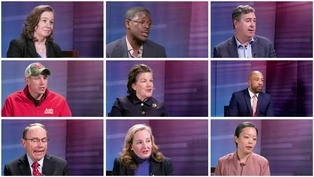
>> We're continuing our look at some of the biggest issues in the race for governor.
As a reminder, you can see the interviews for nine different candidates on our web page, PBS Wisconsin.
Org.
And then click on the news tab.
Here's Zac Schultz asking the leading candidates for governor to show us their track record of bipartisanship and working across the aisle.
>> With a Democratic governor and a Republican legislature.
The last eight years in Wisconsin politics have been defined by gridlock and a lack of trust in the Capitol.
And whether a Democrat or Republican wins the race for governor this fall, there's a good chance the other party will control at least one chamber of the legislature, meaning the next governor will need to know how to work across the aisle to pass a budget.
We asked nine of the leading candidates for governor about their track record of bipartisanship.
>> I'm incredibly proud to have passed the Asian American education legislation that was Republican led, where we had stakeholders from all across the state, a coalition that was multi-generational and multi ethnic, where Republicans and I came together to make sure we delivered for working class families and what they were demanding.
history, again, over 20 years of working with some of the most conservative Republicans to get things done, whether it's criminal justice reform, whether it's helping to pass the first pro-choice legislation in a generation, working with in a Republican anti-choice assembly and getting that passed into law, or just earlier this year, where I helped expand access to rural health care options by allowing nurse practitioners to practice.
And for a long time, I was the only Democrat on that bill.
And Governor Evers vetoed that bill several times.
We finally got it done.
So I have a long history of being able to work well with folks from across the political spectrum.
>> So I've done bills when I was in the legislature and as well as in Congress, working on a bipartisan basis.
And we're going to try to do the same thing.
The thing that I won't get away from is my principles, though.
And number one is we got to make sure that we have balanced budgets.
We cannot spend too much money.
The second thing is we got to do a better job with our educational system public, private, parochial, homeschool, whatever every kid in Wisconsin should expect to get a good education regardless of their zip code.
>> Yeah, I mean, even out of office, I've been working with a bipartisan group on democracy reform because there are a lot of folks, sometimes both sides of the aisle who, you know, may make comments, may say certain things, or, you know, we've seen these issues, obviously, January 6th, but other instances where people call into question the integrity of elections and campaigns.
And, you know, with a bipartisan group we've worked to instill more confidence in the electoral process.
was confirmed twice by the Republican Senate unanimously as secretary of Economic Development.
And if you asked any of them, I believe that they would say they have a record of working with me.
I would also say that I've had a bipartisan board at Wedc for six years, and in that whole time we had two close votes.
Other than that, the board was practically unanimous in many of our moves approving our budgets, passing programs.
So I have a mindset of working with everybody who is willing to come to the table and have good discussions and think about how do we make Wisconsin better.
>> I think this has been one of the things I've been most critical of recently is the lack of communication between the East Wing and the legislative branches.
Both, I mean, look back to the state budget process.
The Democrat minority leader is critical of the Democrat governor for not even giving her a seat at the table in the conversation about the budget.
You know, Greta Neubauer and I probably don't agree on a whole lot.
One thing we do agree on is everybody should have a seat at the table.
90% of things, we probably disagree, but there's probably going to be 1 or 2 where I'm like, yeah, that makes sense.
How do we get to.
Yes.
>> Well, I think I'm somebody who over the course of 30 years has demonstrated that I am a relationship person.
First.
It's something that I have made a point of, and I have ensured that as I go throughout my career, I think I check my ideology at the door when I want to roll up my sleeves and get things done.
It's necessary to do in the nonprofit sector, it's necessary to do in government.
>> You know, I spent seven years in the state capitol.
So, you know, having worked under both Governor Evers administration as well as Governor Walker's administration, I've had to to navigate these political landmines, if you will.
And as the county executive of Milwaukee County, I've worked with the Republican controlled legislature not only to benefit Milwaukee, but every community across the state with the passage of act 12, but continue to work across the aisle even in this most recent budget, where we're going to receive reimbursements for our highway patrol, giving us the ability to invest in our public safety building in our courtrooms to make sure that we can deliver justice for those who need it and take care of those who are in our care.
And so I'm going to always show up and deliver for those that I represent.
And I want communities all across the state to know I'm going to be a governor for everybody, not just one party.
>> So coming from a rhetoric community, I'm used to having those types of conversations with Republicans.
I represented a purple district.
My strategy would be able to do things that have, you know, wild popular support in Wisconsin and be able to start with those types of things.
So whether that is fully funding our public schools, we know that that's something that people want to do within Wisconsin.
We want to make sure that we're going to be able to get some relief for healthcare across, across the finish line.
I'm willing to work with anybody who's going to make life better for Wisconsin.
>> Reporting from Madison.
I'm Zach Schultz for here.
And now.
>> For more on this and other issues facing Wisconsin, visit our website at PBS Wisconsin and then click on the news tab.
That's our program for tonight I'm Frederica Freyberg.
Have a good weekend.
>> Funding for "Here& Now" is provided by the Focus Fund for Journalism and Friends of PBS Wisconsin.
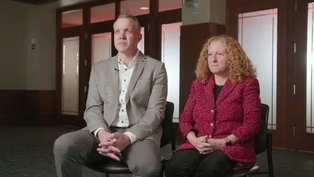
Chancellor Jennifer Mnookin, Chris McIntosh on UW Football
Video has Closed Captions
Clip: S2400 Ep2428 | 11m 44s | Jennifer Mnookin and Chris McIntosh on the performance of Wisconsin Badgers football. (11m 44s)
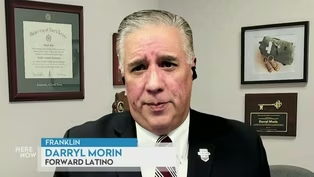
Darryl Morin on Anticipating ICE Operations in Wisconsin
Video has Closed Captions
Clip: S2400 Ep2428 | 6m 44s | Darryl Morin on potential for federal agents to conduct immigration raids in Wisconsin. (6m 44s)
Here & Now opening for January 23, 2026
Video has Closed Captions
Clip: S2400 Ep2428 | 58s | The introduction to the January 23, 2026 episode of Here & Now. (58s)
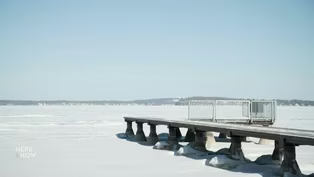
Weather Warnings Issued as Wisconsin'sTemperatures Plummet
Video has Closed Captions
Clip: S2400 Ep2428 | 57s | The National Weather Service issued an Extreme Cold Warning for Wisconsin. (57s)
How Wisconsin's 2026 Governor Candidates View Bipartisanship
Video has Closed Captions
Clip: S2400 Ep2428 | 5m 58s | Candidates in Wisconsin's 2026 race for governor describe working across the aisle. (5m 58s)
Providing Support for PBS.org
Learn Moreabout PBS online sponsorship
- News and Public Affairs

Top journalists deliver compelling original analysis of the hour's headlines.

- News and Public Affairs

FRONTLINE is investigative journalism that questions, explains and changes our world.











Support for PBS provided by:
Here and Now is a local public television program presented by PBS Wisconsin