
Joyce Vance
Season 13 Episode 4 | 26m 46sVideo has Closed Captions
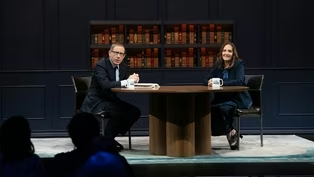
Former U.S. attorney Joyce Vance discusses the changes in federal separation of powers.
Former U.S. attorney and MSNBC legal analyst Joyce Vance discusses the changes in federal separation of powers and her book "Giving Up Is Unforgivable: A Manual for Keeping a Democracy."
Problems playing video? | Closed Captioning Feedback
Problems playing video? | Closed Captioning Feedback
Overheard with Evan Smith is a local public television program presented by Austin PBS
Support for Overheard with Evan Smith is provided by: HillCo Partners, Claire & Carl Stuart, Christine & Philip Dial, Eller Group, Diane Land & Steve Adler, and Karey & Chris...
Joyce Vance
Season 13 Episode 4 | 26m 46sVideo has Closed Captions
Former U.S. attorney and MSNBC legal analyst Joyce Vance discusses the changes in federal separation of powers and her book "Giving Up Is Unforgivable: A Manual for Keeping a Democracy."
Problems playing video? | Closed Captioning Feedback
How to Watch Overheard with Evan Smith
Overheard with Evan Smith is available to stream on pbs.org and the free PBS App, available on iPhone, Apple TV, Android TV, Android smartphones, Amazon Fire TV, Amazon Fire Tablet, Roku, Samsung Smart TV, and Vizio.
Buy Now
Providing Support for PBS.org
Learn Moreabout PBS online sponsorship- [Announcer] Funding for "Overheard with Evan Smith" comes from HilCo Partners, a Texas government affairs consultancy, Claire and Carl Stuart, Christine and Philip Dial, Eller Group, specializing in crisis management, litigation, and public affairs communication, Ellergroup.com, Diane Land and Steve Adler, and Karey and Chris Oddo.
- I'm Evan Smith.
She's a former US attorney from the Northern District of Alabama who you know as a legal analyst for MS NOW, and a successful podcaster and Substacker.
Her first book, "Giving Up is Unforgivable: A Manual For Keeping A Democracy" has just been published.
She's Joyce Vance.
This is "Overheard".
A platform and a voice is a powerful thing.
(audience cheers) You really turn the conversation around about what leadership should be about.
Are we blowing this?
Are we doing the thing we shouldn't be doing by giving into the attention junkie?
As an industry, we have an obligation to hold ourselves to the same standards that we hold everybody else.
Thank you.
This is "Overheard".
(audience applauds) Joyce, my friend, it is so good to see you.
- It is always good to be with you and good to be in Austin.
- Thank you.
Well, we love having you here.
This book is great.
Congratulations on it.
There's never a bad time to write a book about our democracy, but this feels like an especially good time.
- You know, I wondered about that when I was starting out.
I started writing at about the same time that Donald Trump was inaugurated, and so I'm writing, and then I'm tearing up and throwing pages away because things are happening so fast, right?
The big difference between this Trump administration and the first one was the amount of order and preparation and speed with which they executed Project 2025 early on, and so I think because that exceeded what many people, including me, had anticipated, we just didn't think that they would be that competent, to be honest.
It was a tough moment to write about democracy, and then I got my sea legs under me finally.
- What was it that gave you those sea legs?
- You know, early on, I was writing about where we were weak, and what the problems we were facing were, and then I realized what I needed to focus on was where we were strong, and what the path through would look like, and once I did that, once I focused on our constitutional strengths, and the democratic institutions that were nimble enough to survive a moment like this, that's really, I think the footprint for democracy, right?
Donald Trump tries to pretend that he's inevitable, that no one can outrun him once he sets his mind to doing something whether that's fundamentally altering democracy, or, you know, engaging in any of the other misbehavior he engages in, but our institutions, the design of the founding fathers is so strong that that's really the path forward.
- The use of the word manual in this title is helpful, and I think, again, back to this idea that this is not about all the things that are wrong with the world, but what we can do to make the world right.
That is actually novel.
Many of these books about democracy that I've read are mostly people kind of rending their garments over how bad things have gotten, but there's no optimism.
There's no hope in it, and at least here you're telling us, "You have the power to change."
- You know, I have a funky sort of background for this, right, because I'm a law professor, and I do enjoy the academic sphere, but I spent 25 years at the Justice Department.
I was a line criminal prosecutor.
I did appellate work, and then I was the US Attorney for the last eight years, the political appointee, and so a lot of that work was very community based.
It wasn't all that different from being a community organizer, and I think what you understand if you do that is A, Americans are incredibly smart people, B, if you educate them about democracy and how it should work, and what their rights are, they can take it from there, and C, we don't do nearly enough of that these days.
So that was my goal, to empower people to believe that they fundamentally have the ability to control the future of our country.
- Yeah, I wanna come back to this idea that you started with, that you had to rip things up because so much was happening so quickly.
You know, what it's like- - It was a fun couple of weeks.
Lemme tell you.
- You know what it's like to be in the media, of course you're media adjacent, but like literally those of us who run news organizations, who are trying to do reporting on stuff, what we've observed over the last 10 months is the fire hose of news is turned up to the highest setting at all times.
You cannot look away, 'cause you'll miss 10 things, and anything that happens that might have had hang time on the front page of a paper gets pushed aside immediately.
- I went out to dinner last Friday night, and three major court opinions come down while I'm at dinner, and I get home at 10:30, and think, "I have to start reading these."
- The point is, there's no off switch, - Never.
- On this stuff.
And that to me, I mean, I understand that like people say, "Well, you know, you say it's never been like this before.
Everything has happened in some fashion before."
This part of it seems to me a real sea change.
- And this, by the way, is intentional, right.
Dictators like to use overwhelm as a strategy for taking control, and let me tell you what I mean by that.
You know, people who are overwhelmed give up, right, hence the title, and I bet everybody here has had a friend who's said to them, "I'm just so overwhelmed.
I just, I have to unplug.
I can't pay attention any longer."
Many of us feel that way sometimes on a regular basis, and you know, it's so much easier if you wanna take control of a country to have people voluntarily give up their rights and stop looking as opposed to having to take them away from them, so this is something that dictators not only in this country right, where we may well be on the verge of having our first autocratic ruler, but in many other countries that have slid into autocracy, this is the strategy that's used.
- I heard yesterday, former Secretary of Transportation, Pete Buttigieg talk about this moment, and he said something I had not actually heard anybody say before, which is, "Things were bad before, and that was the condition that allowed Donald Trump to do what he's doing."
He said, "In a community, or in a society, where everything is working, it's much harder for somebody with autocratic impulses to be successful."
He said, "We have to acknowledge that things were not working before, and that's why this is working now.'
Do you agree with that?
- A hundred percent, because we know that that's the precondition, right.
Mussolini comes out of a difficult time in Italy's history as does Hitler in Germany, as do many other autocrats, and so here we have a middle class that feels the economy slipping away from them.
They feel less opportunity.
They're looking for a change, and along comes a snake oil salesman who somehow convinces them that a billionaire is gonna protect their interests.
I think that's the mystifying part of this story is why Americans were so ripe to be persuaded by someone who really was selling them a bill of goods, and that's maybe a discussion that historians will have in hindsight, but the reality is, it was a failure in the political moment to address the needs of Americans that got us where we are.
- Do we as Americans bear some of the blame for this?
I mean, I have thought a lot about the kind of, we're the ones we've been looking for aspect to your prescriptions in this book.
No one is coming to save us.
We need to save ourselves, and that means we collectively, and we individually, by taking the sorts of steps which we'll talk about that you outline in here.
There are things we can do, but I also wonder if we should take the L on this, right, on being either susceptible, or not doing enough to see this coming around the road, the bend in the road.
- I mean, I hear that.
I think that there's, you know, maybe some rationale for that, but let me tell you where I stand on it.
We're in too fragile of a moment to waste time assigning blame for what has happened in the past, and why Donald Trump was reelected for a second time.
You know, we've got roughly 11 months to get ready for the midterm elections, which are the critical point where guardrails can be reestablished, where we can pump the brakes on Donald Trump's ability to act without any sort of restraint, and so, you know, if we wanna do some sort of a funereal vivisection of what went wrong after the fact, great, but let's worry about the present.
Let's worry about fixing the problems.
Americans were susceptible.
I suspect nobody in this room, right?
Probably if you're reading this book, or if you're in this audience, whether you at some point were more susceptible to Donald Trump's charms, you've obviously overcome that moment.
I think the problem that we have, frankly, is far too many Americans remain susceptible, I think for a lot of families, right, Thanksgiving dinner is gonna be pretty lit this year (audience laughs) because it will be hard to avoid the gorilla in the room, but let's worry about moving forward together.
- Yeah, I mean, I buy that, but of course ringing in my ears is the old chestnut, "You don't know where you're going unless you know where you've been."
Right?
And like all these books that are narrative histories of the last presidential election are theoretically telling us, "This is what happened and this is why," and the implicit message is, "This is what you have to not do again," right?
And I sort of wonder if there isn't value in that on the democracy front.
What we did got us to this point.
- I mean there are a lot of ways of assessing blame, right?
I live in Alabama.
Y'all are in Texas.
I think many of us- - We're the liberal state compared to your state right now.
(audience laughs) - You know, we are so grateful for Mississippi.
That's the only thing I'll say.
(audience laughs) (audience claps) - You know, the old Molly Ivins line was that "Texas is Mississippi with better roads", right?
- Yeah, yeah.
(audience laughs) And it's true in some ways.
- There's a version- of that, isn't there?
That's exactly right.
- So, look, I think this is difficult for this reason, and it's something I write about in the book.
We're a country that's never had the conversation about race that we need to have.
It's the original sin that the country was founded within.
Kamala Harris, an immaculately qualified person, runs for office, I mean, a knitter.
I'm a knitter, y'all.
I wanted to have a knitter as the president of the United States, but beyond my personal reason to like her, incredibly well qualified, a strong leader, and there were a lot of people who were never going to vote for her because she was black, and because she was a woman, and so, I don't know how you get over that, you know, foundational issue.
I hear a lot of people say, "Well, we need a white guy from the South to run."
Maybe that's true, but I don't love that conclusion, and I would like to believe that we are a better country than that.
There may be other lessons that we can learn from the past, like why didn't young people get out and vote?
That would certainly get us past, right, some of these concerns about finding a candidate who's straight from central casting, and so maybe that's the answer to figure out how do we reach more people in the electorate?
How do we avoid the kind of wedge issues that malicious actors created before the 2024 Election?
- And weaponized.
- Absolutely, right?
- And weaponized.
I mean, of course, I with you- - Convinced Americans to stay home and not vote to teach Democrats a lesson.
That was poison.
- I'm with you on the race and gender thing.
I mean, we might have, at another time, a very polite and spirited conversation about whether the, - Oh, let's do that.
- issue was race and gender, or whether there was also an aspect of she was the incumbent, whether she wanted to be or not, and the country did not like what the incumbency of the last administration was selling.
It turned out to be a status quo election, right.
But let me come back to this.
When people hear the word democracy these days, do they hear the same thing?
Like, I wonder if the word democracy at the moment has kind of gone gray, depending upon who you are, where you are, you may hear different things when that word is used.
- This, I think, is a concern that has not been addressed as much as it should be.
You know, democracy means one thing to somebody like me, raised in part by an immigrant granddad who had deep love for this country, because it saved, you know, my Russian Jewish family from pogroms, right.
Coming to this country is what made our continued existence possible, and he taught us democracy every day.
Fast forward to my 22-year-old who I was having a conversation, I really wanted him to read my book, which he won't do.
- He he won't do it?
- And I said, well, I think he actually has now.
He's just not gonna give it up for me.
But I said to him, "What would it take for you to read a book?"
And so we were having this conversation about his perception of democracy, and he said, "Mom, I was four years old when the occupy protests happened, and nothing has changed.
The country is still controlled by rich men.
You know, Congress and the caucus is controlled by wealthy interests.
Nothing has changed."
And so his idea of democracy is Donald Trump as the president.
He does not have a memory, as an adult person, in advance of that.
To me, democracy is what saves us.
To him, democracy is something that's broken, and that means we need to have more sophisticated conversations.
- And the thing is, generationally there's a difference in how you hear the word, geographically.
- Absolutely.
- There's a difference in how, I mean, I know it's a cliche at this point to say, "You know, oh, there's a rural urban divide in our politics" and that's partly the issue.
The fact is it's a cliche because it's true.
- Exactly.
- Right, and I'm not sure that a conversation around democracy in rural communities necessarily hits the same way.
- You know, I think that that's right, and so something I write a lot about in the book, but think about even more in real life is failed civics education in this country, and this notion that people are able to believe that democracy isn't in their best interest, but that an autocratic, wealthy guy calling the shots in Washington will serve them.
That tells me that we need to completely rethink how we talk about democracy, the rule of law, and the future of the country.
- Yeah, so I wanna go on to prescriptions because I wanna talk to you about a couple of things not in this book.
So the last part of this book gets to what you call rules for the calvary, things that all of us should be thinking about that we can do, and I want to ask you about a couple of those.
The first is, be smart, which really gets to make a clear distinction between what is reliable, good, credible information.
Don't be dissuaded by disinformation.
Don't be sucked into that vortex of conspiracy theories and all that.
That's easier said than done for a lot of people.
- It is, and it's such an obvious thing.
I mean, it's why it's the first thing.
So my point here is that we are the cavalry, right.
If we are waiting around for someone to save us, not happening.
The courts aren't gonna save us.
Congress won't save us.
There are good people in both of those places, and they will contribute, but ultimately it will be up to us to keep our eye on the ball, to direct government, something that we've really lost sight of doing.
You know, the founding father's vision was elected representatives who were responsive to the electorate, and how many times I've talked with people who've just thrown their hands up in the air and said, "I have two red Senators.
There's nothing that I can do."
Well, look, we have to dig a little bit deeper and make sure that those people understand that we elect them, and that they have to work for us.
They have to talk to us, and so that's my notion of us as the cavalry, us as voters, us as citizens, and to do that, we've got to be better informed.
It's so easy right now, and I think in some ways just sort of cheap to say, "We have to avoid disinformation."
And the better question is, "How do we do that?"
- Well, the media environment is now contributing to that.
- [Joyce] It's poisonous, right?
- Yeah, it is.
Alright, so let me ask about another one of these.
Understand that protecting democracy comes in a lot of flavors, what works for someone may not work for somebody else, how we may see the problem, or diagnose it, or come up with a solution may not be the same as somebody else does.
- Yeah, exactly, and you know, so I started thinking about this when one of the students in my law school class on democracy, where the students write a major research paper, sort of the capstone of their law school career, and she came to me and she said, "I wanna write a paper about art and democracy."
And I thought, "Well, that's different."
And as we began to do her research and explore her ideas, she really wanted to think about how art can educate people about democracy and motivate people.
And so I think we all come at it from different aspects, whether it's a substantive role of democracy.
And you know, here again, my academic experience informs me.
I co-teach every year with colleagues from the Department of Public Health at the University of Alabama at Birmingham.
Public health plays a strong role in democracy, and they have very serious views.
They come at it at a very different direction from me.
What I love is when we have the opportunity to let everybody do what impacts them, what resonates with them, we get a much richer flavor of support for democracy.
- I think being less rigid about empowering people to be their own change makers, right.
- Absolutely.
- It makes a lot of sense, because again, a lot of differences in this country, differences in our communities.
People have to arrive where they arrive.
- This is very much the rationale for the democrat's big tent, you know, as opposed to Republicans who've always been a little bit more rigid, and have demanded fidelity to party policy, which is what makes them so effective, Democrats have this unruly big tent, and that I think is just inherent in democracy.
- Let let me ask you about this idea, be the hope.
That's one of the prescriptions.
Really what it means is things may look bad, but you have to keep going.
Don't give up.
I mean, that's kind of fundamentally the point of the book, isn't it, Joyce?
- I mean, it really is.
Look, I wrote this book, or I conceived the idea for the book after the election.
Kamala Harris had just lost.
I got really nervous, because I began to hear a lot of people saying, "I did everything that I could during this election, and we lost, and I have nothing else left to give.
I just need to walk away."
And it occurred to me that Donald Trump walking into office with no public there to check him, no one to call him out when he engaged in misconduct was unbelievably dangerous, and that we need, you know, we could take a little bit of time to collect ourselves and then we needed to get to work.
And I'm blessed with a wonderful group of friends around me on days, and look, there are days where I look at what's going on, and I think it's devastating, and so I talk with my friends, and they pick me back up, and they remind me that we've had successes.
- I mean, I remember, after he was elected the first time, people in communities like the one that I live in with signs, he's not my president, and I thought, "Actually he is your president."
And by denying what is reality, you impede your ability to figure out what do I do now, and what do I do next?
- And I mean, not only were there signs, there were people knitting the pink pussy hats.
There were big protests, like the Women's March.
People were animated, and after the reelection, it felt like people simply were ready to give up and walk away, and so I think to this day, it's important for all of us to be intentional about supporting people around us.
- You mentioned Congress and the courts.
One of the things that occurs to me is that a lot of the traditional guardrails do not seem to be working.
Right?
Congress was always a check on the Executive.
Well, Congress right now is basically ceased to be a check on the Executive at all.
Can't really rely on the courts.
I'm afraid, my folks in the media have not necessarily met this moment as a guardrail.
We are our own guardrail, right?
- Let me push back a little bit, even though I agree with you that we are the best guardrail, District Court judges, Federal District Court judges across this country, issuing unbelievably brave and correct legal rulings, even though they know that doing it means that the president is likely to put a bull's eye on their back, and subject them and their families to really dangerous situations, and look, if we're gonna stand up and applaud for one institution in American society, it should be those District Judges and Courts of Appeals Judges who are taking it to the Supreme Court.
Judge Wolf in Boston resigned last week.
- Resigned last week, right.
- So that he could speak out.
I think the Supreme Court- - And he was a Reagan appointee.
- He was, yeah.
- The Supreme Court will ultimately, I think, be forced to confront what they've done.
Will it cause them to rightsize?
Who knows, but my hope in that regard is that the Supreme Court does not wanna become completely irrelevant, and if they go along with this argument that the Trump administration is now pushing in cases like SNAP and the National Guard, that once the president has made a decision, the courts can't review it, I think the Supreme Court has to push back, or it simply becomes irrelevant, so there's that, right.
And I think in Congress, I mean, who knew that Marjorie Taylor Greene would have a breakup (audience laughs) with Donald Trump on a Friday night, right?
- Yeah, right.
- But to your point, that, and also the media, which has struggled to figure out how to deal with this president, and in some cases has behaved shamefully, I think it's just been a tough time.
I view it as a synergy.
I think if we the people are the cavalry, I think if we demand that the institutions perform better, and also let them know that we have their backs.
I think that's the path forward.
- Yeah, and then of course, the ultimate prescription is vote - It is.
- Right, I mean, that's the thing.
What did President Obama say for all those years?
- "Don't boo, vote."
- "Don't boo, vote."
Because, at the end of the day, it sort of gets back to the conversation we're having earlier, complaining is fine, but you've gotta figure out a path forward, and that involves action, and in this case, action is voting.
- It does, and this administration knows that, right.
They wouldn't be working so hard to deny people their right to vote unless they understood how powerful the right to vote is.
That's why we're seeing this measure to come up with this fake narrative.
It is demonstrably fake about non-citizens voting and using that as an excuse to implement a lot of measures that will suppress legitimate people, legitimate citizens from voting.
- And even, you know, the insecurity of mail ballots all of a sudden is another thing that we're now hearing about, and you actually think the midterms is, so that's the ball game, because if the Democrats regained control- - Look, can I just say though- - of one House, then they can slow to a crawl the agenda of the administration.
- It's not necessarily ballgame, but if we are able to return some checks and balances on this administration, whether they come from Republicans or Democrats, - The Democrats.
- Then that will be a huge step in maintaining democracy, and so there may be Republican candidates out there, you know, who will do a great job.
A lot of Democrats are very active and aware.
I think our responsibility as citizens is to educate ourselves about the options, maybe to consider running ourselves, or maybe to work in polling places to protect the integrity of the elections.
Everybody has a role to play in restoring guardrails.
- I think working on elections and all that, great, totally agree, and we need to support the people who do that work because those people are increasingly under fire.
- [Joyce] They are, yeah.
- God, running for office these days seems like the worst thing ever.
- What a thankless job, right?
- Oh my God.
Well, also it's like, "Bad news, I ran for congress.
Bad news, I lost, worst news I won," right?
(audience laughs) - This is very true.
You know, I don't know if any of y'all have seen Doug Jones, there's been speculation in the media.
- Might run for Governor of Alabama - Against Tommy Tuberville, Alabama's senator who's leaving the Senate to run.
- And who beat Doug Jones, didn't he?
- He did.
- For the Senate, right.
- And so I think that takes a certain amount of bravery for a Doug Jones to decide to get back into the fight.
I think we'll see that across the country.
Roll tide.
It's a great day for Alabama.
- Roll tide in Texas is, that's bravery on your part.
(audience laughs) - I thought, yeah.
You know, I came down the elevator in my hotel this morning with a couple from LSU, and it didn't come to a fist fight in the elevator, but it was close.
(audience laughs) - Close.
(audience laughs) Well, I'm gonna simply say hook 'em, (Joyce laughs) and Joyce Vance, it's always good to be with you.
I'm so happy for your success.
- Thanks so much for having me.
- Give Joyce Vance a big hand.
(audience applauds) Thank you so much.
We'd love to have you join us in the studio.
Visit our website at Austinpbs.org/overheard to find invitations to interviews, Q&As with our audience and guests, and an archive of past episodes.
- We're living in a moment where we have, you know, kleptocracy and kakistocracy, right?
We have corruption and we have incompetence, and people need better models for leadership.
Somebody said to me this week, "Readers are leaders, and leaders are readers", that old truth, and so we need to have the opportunity for fresh leaders to be developed.
- [Announcer] Funding for "Overheard with Evan Smith" comes from HillCo Partners, a Texas government affairs consultancy, Claire and Carl Stuart, Christine and Philip Dial, Eller Group, specializing in crisis management, litigation and public affairs communication, Ellergroup.com, Diane Land and Steve Adler, and Karey and Chris Oddo.
(whistling tunes)
Video has Closed Captions
Clip: S13 Ep4 | 5m 29s | Former U.S. attorney Joyce Vance discusses the changes in federal separation of powers. (5m 29s)
Providing Support for PBS.org
Learn Moreabout PBS online sponsorship
- News and Public Affairs

Top journalists deliver compelling original analysis of the hour's headlines.

- News and Public Affairs

FRONTLINE is investigative journalism that questions, explains and changes our world.










Support for PBS provided by:
Overheard with Evan Smith is a local public television program presented by Austin PBS
Support for Overheard with Evan Smith is provided by: HillCo Partners, Claire & Carl Stuart, Christine & Philip Dial, Eller Group, Diane Land & Steve Adler, and Karey & Chris...