
Largest Corn Harvest
4/6/2026 | 26m 30sVideo has Closed Captions
Rice farmer sells directly to consumers. Virginia corn grower reaps nation’s largest harvest.
Discover how a California rice farmer sells his crop directly to consumers. Wisconsin high school students open their cookbooks to exchange “sweets and treats” for a lesson in healthy eating. On Farm to Fork, try out a turkey burger recipe you’ll want to “gobble” up. And meet a Virginia farmer who set a national record in hauling in the nation’s largest harvest of corn.
Problems playing video? | Closed Captioning Feedback
Problems playing video? | Closed Captioning Feedback
America's Heartland is presented by your local public television station.
Funding for America’s Heartland is provided by US Soy, Sustainable Agriculture Research and Education, Rural Development Partners, and a Specialty Crop Grant from the California Department of Food and Agriculture.
Largest Corn Harvest
4/6/2026 | 26m 30sVideo has Closed Captions
Discover how a California rice farmer sells his crop directly to consumers. Wisconsin high school students open their cookbooks to exchange “sweets and treats” for a lesson in healthy eating. On Farm to Fork, try out a turkey burger recipe you’ll want to “gobble” up. And meet a Virginia farmer who set a national record in hauling in the nation’s largest harvest of corn.
Problems playing video? | Closed Captioning Feedback
How to Watch America's Heartland
America's Heartland is available to stream on pbs.org and the free PBS App, available on iPhone, Apple TV, Android TV, Android smartphones, Amazon Fire TV, Amazon Fire Tablet, Roku, Samsung Smart TV, and Vizio.
Providing Support for PBS.org
Learn Moreabout PBS online sponsorship>> Hi I'm Sarah Gardner.
Just ahead, we'll introduce you to some people who play a significant role in what you serve for dinner... now....and in the future.
We're serving up some popular poultry and heading back to class for a lesson in good eating.
We'll cross the country to California's rice fields where one young farmer has found success in delivering his crop from farm to restaurant table.
Everyone loves a winner!
Rob Stewart heads to Virginia where this farm family takes the prize in a huge harvest of corn.
Sharon Profis is back in the kitchen!
This time she's serving up a turkey recipe that's sure to be one of your favorites when it comes to poultry.
And I'll take you back to school in Wisconsin to check on a program that helps students make the right choices when it comes to good eating.
It's all coming up on America's Heartland.
>> America's Heartland is made possible by America never stops.
Neither do the farmers and ranchers who call her home.
And as rural America grows further, Farm Credit will be there.
Just as we have for one hundred years.
>> CropLife America.
Representing the companies whose modern farming innovations help America's farmers provide nutritious food for communities around the globe.
>> The Fund for Agriculture Education.
A fund created by KVIE to support America's Heartland programming.
Contributors include the following.
♪♪ You can see it in the eyes of every woman and man ♪♪ ♪♪ In America's Heartland, livin' close to the land ♪♪ ♪♪ There's a love for the country ♪♪ ♪♪ And a pride in the brand ♪♪ ♪♪ In America's Heartland ♪ ♪♪ Livin' close... close to the land ♪♪ ♪♪ >> Thanks for joining us on America's Heartland.
Let's start with some changes in what we eat for lunch and dinner.
Americans consume three times the amount of rice they did a generation back on average about 31 pounds per person each year.
Rice is a key ingredient in meals at both Asian and Hispanic restaurants, but rice also plays a major role in cereals, food additives, even beer.
California is a major producer of rice, Our Jason Shoultz visits one farmer looking to deliver his harvest to new markets.
♪♪ >> Northern California Chef Billy Ngo knows sushi.
>> The rice is the most important part of sushi.
>> And his Midtown Sacramento Kru restaurant sits in the heart of California rice country.
We have all the recipes written down and everything, we haven't gotten here and started making anything yet.
>> So 9 years ago farmer Michael Bosworth sat down at Billy's sushi counter with a sales pitch.
Why not buy his organic rice directly instead of through a supplier?
>> Back then I was like, I think, first year open, and I was like well how much is it?
And then, and then I was like why would I need to pay that much more for that rice, compared to conventional rice?
♪♪ >> As a concept, farm to fork is a slam-dunk.
As a practical matter it often means farmers like Michael Bosworth making the case that paying more for local or organic is worth it for customers.
Bosworth's family had been farming rice conventionally for decades when he decided to go into direct sales in 2005.
>> But there were a lot of lot of phone calls, lot of driving around; lot of samples and it wasn't easy by any stretch of the imagination.
>> It can be a tough sell, especially when restaurant margins are thin.
Beyond doing their own marketing, farmers like Michael end up tackling logistics.
Going around established distribution and sales systems.
For Michael that means filling up every nook and cranny of his delivery pickup truck.
A truck with how many miles?
>> 267,000 this morning.
>> But that hard work has paid off.
10 years in, Michael now sells his rice to restaurants and food service customers.
Even direct retail across Northern California.
>> Our idea was to establish that relationship and help to differentiate our farm from others and provide a direct link of communication with our customers, hear their feedback, understand if they are interested in other varieties or what we can do to make their side of the business work well.
>> And his farm to fork venture is entering a new phase.
Success selling his own rice has led to other smaller farmers and food-makers coming to him for distribution.
>> So we thought, hey let's all put everything in one truck and get it down there for one guy to order and he knows, hey, on Thursday I'm going to get my order of all these locally grown products, I don't have to talk to 10 different farmers and worry about when they are all going to show up.
>> Of course, Billy Ngo did end up buying Bosworth's rice.
Their relationship is such that Billy actually now works with Michael on what varieties of rice he would like for his restaurant.
Thank you!
>> That was really cool to have that relationship with a farmer, having something grown for us, and he'll just ask us if there's anything, other types of rice we'd like to grow.
>> He suggested that you know, maybe he wanted to try a high quality Japanese style short grain, so we started growing that for him, and his restaurant.
>> So what did the trick?
How did he convince Billy Ngo to spend a little more for his organic rice?
Well, it wasn't a slick marketing campaign.
A trip to the farm in the pickup truck.
>> Finally I invited him up to the ranch during harvest and he came up and drove the harvester with me, and you know, walked through the fields.
>> Speaking of that old farm truck, the farm to fork sales for Bosworth are going well enough that it's time for an upgrade.
>> We're getting a new truck, huh?
>> Yeah we're finally upgrading to a new truck, the old F150 just can't keep up anymore.
We've been here since 1946, so it's pretty special to continue that tradition and continue to nurture the land that has provided for our family for decades.
>> Rice is the primary food source for a significant portion of the world's population.
It's grown in more than a hundred countries on every continent except Antarctica.
Use plenty of water when you're preparing rice.
That's because cooked rice will swell to more than three times its original size.
>> Whether its rice or another crop, farmers like it when the weather cooperates and they're able to get their crop into and out of the ground fast and efficiently.
When that happens, it's a good bet they'll have a harvest to brag about.
That seems to be the case for one farmer that Rob Stewart met in Virginia.
He and his family have touched on a formula that's delivered prize winning results.
♪♪ >> We have some good dirt, it covers up a lot of mistakes that I make or we make.
So we have had some really good successes with corn.
>> You might say David Hula is a master of understatement...and maybe a bit too modest.
After all, when you've been a top-producing corn grower in America year after year after year, it's probably not just luck or divine providence!
>> The National Corn Growers Association, they have an annual contest, a yield contest.
We won overall, so we were blessed that we had the highest yield in the whole country.
>> In the U.S., the average yield is 150 bushels an acre.
David's corn yield in 2011 was 429 bushels, almost three times bigger, beating out more than 7,000 competitors from across the nation.
>> We try to start out with good genetics and then we just kind of spoon-feed the crop throughout the season, pay a lot of attention to the details, give it good plant health.
>> For four generations since the 1930's, the Hula family have been farming this rich land by the Saint James River, and not just corn.
>> We're also in the seed business.
We raise a lot of soybeans for a company that we part own and we have some public varieties that we raise.
And then we have some wheat, soft red winter wheat.
We still are one of the few that grow barley, and we're still one of the few that still grow oats around here.
>> Drought is a reality faced by all farmers and water conservation has become even more critical.
And conserving scarce water is why David has invested in this high-tech drip irrigation system.
Most of the pipes are beneath the surface.
The water is mixed with fertilizer going right to the roots.
And this high-tech gadget uses solar panels and satellites to check moisture levels as deep as five feet below the surface.
>> I can log in and, just like checking emails, I check how much moisture is in the ground.
We can also document whether we're doing right, wrong, or how we can fix some problems if we over water or under water.
>> After the harvest and the almost-yearly accolades, the Hulas still find they need to generate other revenue streams.
That's one reason they share their farm with city folks.
A giant corn maze each autumn, a farm museum, a collection of old farm signs and antique equipment including this seed cleaner.
A place to share the history of agriculture.
♪♪ >> Most people will say being the best at something usually means you have to love doing it.
The Hulas are quick to express that they feel the same affection, and gratitude for the land and for what all their hard work brings to those benefiting from their bounty.
>> The more we show our urban neighbors that we're not competing for anything they've got going on and that we're good stewards, that helps us.
We're out here and we're helping their lifestyle by giving them the safest, best food in the world, and we're trying to feed the globe.
♪♪ >> Take a guess on how many kernels you'll find on an ear of corn.
Any idea?
Well, one ear of corn will average 800 kernels arranged in 16 rows.
Corn is America's number one agricultural crop but it's grown everywhere around the world except for Antarctica.
♪♪ >> My name is Nancy Martin, I'm a large animal veterinarian and that means I spend a lot of my time driving from ranch to ranch working on preventive health projects for cattle, sheep, swine, humane animal rescue.
The first ranch might be a place where I'm semen-testing bulls.
Why am I doing that?
Because one bull produces 30 to 50 calves annually and if his semen is no good or he's lame or he can't do his job, people want to know about it.
Maybe the next ranch is pregnancy detection in some cows.
OK, lets pull him right up over here.
And use all your best handling skills.
Good boy.
Then maybe I'll go over to a horse ranch and I'll be looking at somebody's horse who maybe has not lameness but a performance deficit.
About 80% of the profession is now female.
I think the profession is associated with care giving, nurturing, developing, prevention those things kind of all go together.
So were recognizing that being a healthy animal or companion to us involves a more holistic look at their health care.
In humans we know that bad teeth, dental disease can contribute to heart disease, kidney disease.
It does the same thing in animals.
This treatment for Meta is help her with stiffness.
And so we want to make sure that they have a long life and then the best quality of life.
When they're well cared for and their needs within their species are met, we get a better product, we feel better about how we got that product, and we feel better about ourselves.
♪♪ >> Let's make a farm to fork connection to the foods on your dinner table.
We mentioned earlier in the show that rice consumption has more than tripled from a generation back.
Want another figure?
Americans are eating twice the amount of turkey than they did in 1970.
Now turkey is one of those foods you see on the shelf in the meat department, but may not consider except for holiday meals.
Well, our Sharon Profis has some suggestions on other options for serving up this very popular poultry.
♪♪ >> A lot of people think about turkey around Thanksgiving but I eat it about once a week, and I'm not talking about the whole bird, I'm talking about ground turkey.
It's easy to cook, it cooks fast, and it's really healthy, so if you're looking for an alternative to red meat, turkey is a really great option.
And what we're making today are my Mediterranean Style Turkey Burgers.
They're really filling because turkey is high in protein and low in fat.
And for this recipe I went with ground turkey that's 85 percent lean and 15 percent fat.
So that leanness comes from the breast and of course that 15 percent will come from the darker meat.
So we'll start with half an onion that I'm just going to get into a very small dice, later on we'll make a Green Goddess Dressing that you can use on these burgers and if you have extra, save for the rest of the week.
A half an onion goes in with the turkey, this is just about one pound of turkey, that'll give us 4 or 5 patties but you can easily double or triple this recipe.
Now let's brighten up the dish a bit.
I always put cilantro and parsley in my burgers, they add so much flavor and they give the burgers a really beautiful fresh color, so we'll call this about one quarter, third cup of each.
>> Smells amazing in here, and now we have to spice it up.
I have a table spoon of Sweet Paprika.
This is going to add color and a subtle peppery flavor.
I also have an ingredient that's getting a lot of attention now, it's called Za'atar, you can also find it under the name Hyssop.
Basically it's a Middle-Eastern Thyme, sometimes it's labeled as Oregano, but it has a really wonderful herby flavor that's unlike anything else.
And we'll add about half a table spoon of ground garlic, black pepper, and a tea spoon of salt, that's my general rule, one tea spoon of salt for one pound of ground meat, that you can adjust accordingly.
>> Now before we mix this all up I want to add just one more punch of freshness.
We're adding lemon zest, so we will zest about three quarters of this lemon right in here.
I'm going in here with my hands because you can't mix a burger with a spoon, so let's mix.
You don't want to over mix it and you also don't want to compress the meat too much.
>> Perfect.
The meat is mixed, so I'm going to wash my hands before we actually form the patties.
The secret to forming the patties so that you don't get a sticky mess all over your hands is to do it with wet hands.
This is a trick that my mom taught me, just run your hands under a little bit of water, and you're set, look at that, perfectly clean.
Remember the meat will shrink a little bit when we cook it so you want to make them a little bit bigger than your buns.
>> Next we're going to make the Green Goddess Dressing and in the meantime we'll put these in the fridge.
You can make these ahead of time in which case you can put them in the freezer and they freeze beautifully.
>> This dressing comes together so quickly because we're doing it all in the food-processor, so we already have about half a cup of Mayonnaise in here, I'm going to add to that just a bit of Feta Cheese, so I put Parsley, fresh Basil, I have three green onions in here and two cloves of fresh garlic, some lemon juice, and our final ingredient is Anchovies, I promise this dressing won't taste like them, it's just going to add another layer of flavor and umami that's going to make it stand out, so about four anchovies right in there.
Let's mix it up.
(Food Processor) >> Mmm..., that is perfect, it's going to go so great on our burgers and it doesn't even need salt because of the anchovies and that feta cheese, so let's cook the burgers.
>> If you're not going to grill these burgers on a barbeque, the next best thing a cast-iron pan.
I'm only going to cook two at a time so as to not crowd the pan.
If you put too many in at once, then it'll just start steaming and you'll never get that browned crispy crust that you want out of a burger, so about 3 or 4 minutes on each side until they're thoroughly cooked.
Let's check on these, Oh yeah, that is perfection.
>> These burgers look so good you would think we barbequed them, and now it's time for my favorite part, assembly.
So we have our Green Goddess Dressing, I put it in the fridge while we were cooking the burgers just to let it set a little bit, I also can't have a burger without a little avocado, tomato, and check out these burgers, they turned out so juicy.
Little bit of spring greens, and now you have a burger.
♪♪ >> Let's clear up a myth and give you one more word on turkeys.
The Franklin Institute says that Benjamin Franklin never proposed the turkey as a symbol for America, but he did praise the wild turkey as a much more respectable bird than the bald eagle.
♪♪ >> Everybody has their favorite when it comes to food.
That's why it's sometimes hard to get everyone to agree on what they want for dinner even on what the youngsters want to take in their lunch to school.
For generations kids have been told to eat their fruits and vegetables, but we know peas and carrots often get passed up for sweets and treats.
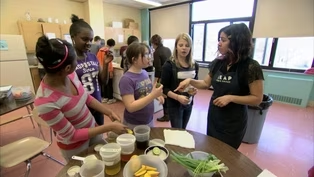
But let's take you to Wisconsin where an innovative program connects school children to chefs and local farms to encourage healthy eating.
♪♪ >> Hi everybody.
I'm Chef Liz with REAP.
>> Elizabeth Chapa is giving these Wisconsin seventh graders a class in the art of cooking.
>> Here's the spinach.
All I want you to do is kind of rough chop it.
>> Most of the foods in her recipes are farm fresh vegetables grown within a hundred miles of the school.
>> We live in an age of a lot of single parent households.
And it's rush-rush-rush, go-go-go.
And I think that what we bring to the kids is an opportunity to slow it down, make a meal with local, healthy ingredients, and show that it can be easy.
>> And when you finish, you don't always have to use all of the dressing, you know what I mean?
Put a little bit, toss it on together, see if it needs more.
>> This class in Madison, Wisconsin is part of a national Farm to School Program organized and administered here by Wisconsin's R-E-A-P or REAP Food Group, which stands for Research, Education, Action, and Policy.
>> And it's not a demo.
It's really the kids being able to get in there and chop the vegetables and cook and then share a meal with their friends and the guest chef.
And celebrate food and learn some new skills and usually try some new things.
>> More than a hundred students are involved in the cooking class, which allows the youngsters to prepare...and then...enjoy their culinary creations.
>> My mom like cooks with me, and I love cooking.
So, I'm glad we made this.
>> So the different types of vegetables and fruits that they're not familiar with, that really gives them an insight like realizes that they are a lot different types of vegetables instead of just carrots or just corn or just strawberries.
♪♪ >> Joey Dunscombe is the executive chef of the Weary Traveler restaurant in Madison.
>> He's also another contributor to the Chef-in-the-classroom program.
He says it's been a rewarding experience.
>> Teaching the kids now, they're just going to grow into that.
Hopefully my kids will be in that group, that group of kids that says no, even at 16, I'm going to go to the farmer's market.
>> Dunscombe is also active in another REAP program - their Buy-Fresh Buy-Local project.
>> It's something I can find sporadically locally.
I've got one guy that picks it.
>> Working with a REAP coordinator; he plans his menus around meat and produce he can obtain from local farms.
>> It's a full circle type of thing.
You know, we keep the money in the neighborhood, or at least in the community.
>> With our current estimated numbers we're over three million dollars' worth of local food being purchased from the farmers themselves.
So, it's pretty awesome.
And in the program we have huge support.
We have 37 different restaurants currently.
We have two grocery stores, one being the neighbor to the co-op right to the Weary.
And then we also have two health care providers.
>> And there's another aspect to the REAP program - culinary training for adults.
>> Radishes.
Pretty dirty.
>> Some of these folks are members of Ameri-Corps preparing fresh snacks for Madison's elementary school pupils.
>> I really like the concept of trying to get healthy food into the local schools and working with students who didn't necessarily have a background in growing food or gardening or farming, and kind of bring that understanding of where our food comes from to them.
>> REAP's Chef and Snack programs serve thousands of students in the Madison schools each week and provide a valuable market for fruits and vegetables from more than a dozen regional farms.
>> And our local farmers are really excited.
It's always fun to approach a farmer and explain what we are doing and talk to them.
And they're always so excited that their produce is going to feed kids in the schools.
♪♪ >> Before we go, we are always happy to pass along information about agriculture.
Our website is a great place to start.
You'll find us at AmericasHeartland.org.
And don't forget we can connect with you on Facebook or check us out at our America's Heartland channel on YouTube.
That's going to do it for us....thanks for traveling the country with us on America's Heartland.
♪♪ You can see it in the eyes of every woman and man ♪♪ ♪♪ In America's Heartland, livin' close to the land ♪♪ ♪♪ There's a love for the country ♪♪ ♪♪ And a pride in the brand ♪♪ ♪♪ In America's Heartland ♪ ♪♪ Livin' close... close to the land ♪♪ >>America's Heartland is made possible by... America never stops.
Neither do the farmers and ranchers who call her home.
And as rural America grows further, Farm Credit will be there.
Just as we have for one hundred years.
>> CropLife America...Representing the companies whose modern farming innovations help America's farmers provide nutritious food for communities around the globe.
>> The Fund for Agriculture Education.
A fund created by KVIE to support America's Heartland programming.
Contributors include the following.
♪♪
 New
NewVideo has Closed Captions
Discover how a California rice farmer sells his crop directly to consumers. (5m 2s)
 New
NewFarm to Fork: Mediterranean Turkey Burgers
Video has Closed Captions
Try out a turkey burger recipe you’ll want to “gobble” up. (6m 49s)
 New
NewVideo has Closed Captions
Meet a veterinarian focusing on livestock health. (2m 8s)
 New
NewVirginia Hula Farm Record Corn Harvests
Video has Closed Captions
Meet a Virginia farmer who set a national record in hauling in the nation’s largest harvest of corn. (4m 7s)
 New
NewWisconsin Farm to School Programs
Video has Closed Captions
Wisconsin students open their cookbooks to exchange sweets for a lesson in healthy eating. (4m 38s)
Providing Support for PBS.org
Learn Moreabout PBS online sponsorship
- Food
Christopher Kimball’s Milk Street Television
Transform home cooking with the editors of Christopher Kimball’s Milk Street Magazine.






Support for PBS provided by:
America's Heartland is presented by your local public television station.
Funding for America’s Heartland is provided by US Soy, Sustainable Agriculture Research and Education, Rural Development Partners, and a Specialty Crop Grant from the California Department of Food and Agriculture.