
Mars: The Moons of Mars
Clip: Special | 1m 4sVideo has Closed Captions
Will Mars' moons survive?
Mars has two moons: Phobos and Deimos. Both are very interesting and both are in danger of destruction. Find out why.
Problems playing video? | Closed Captioning Feedback
Problems playing video? | Closed Captioning Feedback
Science Trek is a local public television program presented by IdahoPTV
Major funding for Science Trek is made possible by the Laura Moore Cunningham Foundation, with additional funding provided by the Idaho National Laboratory, and by contributions to the Friends of Idaho Public Television from viewers like you, thank you.
Mars: The Moons of Mars
Clip: Special | 1m 4sVideo has Closed Captions
Mars has two moons: Phobos and Deimos. Both are very interesting and both are in danger of destruction. Find out why.
Problems playing video? | Closed Captioning Feedback
Where to Watch Science Trek
Science Trek is available to stream on pbs.org and the PBS app.
Science Trek
Science Trek is a place where parents, kids, and educators can watch short, educational videos on a variety of science topics. Every Monday Science Trek releases a new video that introduces children to math, science, technology, engineering, and math (STEM) career potentials in a fun, informative way.[MUSIC] Joan Cartan-Hansen, Host: Mars has not one but two moons: Phobos and Deimos.
Phobos is about 14 miles across.
It orbits only 37 hundred miles above the surface of Mars and zips around the planet three times a day.
Deimos is smaller at only about eight miles across.
It orbits more than 12 thousand miles above the surface.
And takes about 30 hours to travel around Mars.
Both look more like asteroids.
They're shaped kind of like lumpy potatoes and have lots of craters on their surface.
And unlike our Moon, the moons around Mars are not in a stable orbit.
Phobos is slowly spiraling inward to the surface.
So within 50 million years, it will either collide with Mars or break apart into a ring of rubble.
Deimos, on the other hand, is slowly drifting away from Mars.
It will eventually just float off into space.
If you want to learn more, check out the Science Trek website.
You'll find it at ScienceTrek.org
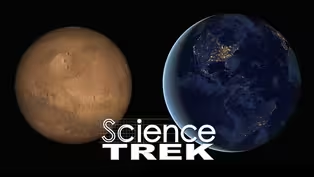
Mars: Mars and Earth, How Do They Compare?
Video has Closed Captions
Clip: Special | 1m 4s | Compare Earth and Mars. (1m 4s)
Providing Support for PBS.org
Learn Moreabout PBS online sponsorship
- Science and Nature

Explore scientific discoveries on television's most acclaimed science documentary series.
 From My Station

 New Season
 New Season






Support for PBS provided by:
Science Trek is a local public television program presented by IdahoPTV
Major funding for Science Trek is made possible by the Laura Moore Cunningham Foundation, with additional funding provided by the Idaho National Laboratory, and by contributions to the Friends of Idaho Public Television from viewers like you, thank you.