
Robert Draper
Season 14 Episode 1 | 26m 46sVideo has Closed Captions
Journalist Draper discusses what it is like to cover American politics in this extraordinary moment.
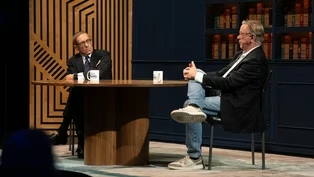
Journalist Robert Draper is a domestic correspondent for The New York Times, and an author of six books. He discusses what it is like to cover American politics in this extraordinary moment.
Problems playing video? | Closed Captioning Feedback
Problems playing video? | Closed Captioning Feedback
Overheard with Evan Smith is a local public television program presented by Austin PBS
Support for Overheard with Evan Smith is provided by: HillCo Partners, Claire & Carl Stuart, Christine & Philip Dial, Eller Group, Diane Land & Steve Adler, and Karey & Chris...
Robert Draper
Season 14 Episode 1 | 26m 46sVideo has Closed Captions
Journalist Robert Draper is a domestic correspondent for The New York Times, and an author of six books. He discusses what it is like to cover American politics in this extraordinary moment.
Problems playing video? | Closed Captioning Feedback
Where to Watch Overheard with Evan Smith
Overheard with Evan Smith is available to stream on pbs.org and the PBS app.
Buy Now
Providing Support for PBS.org
Learn Moreabout PBS online sponsorship- [Announcer] Funding for "Overheard with Evan Smith" comes from HillCo Partners, a Texas government affairs consultancy.
Claire and Carl Stuart, Christine and Philip Dial.
Eller Group, specializing in crisis management, litigation, and public affairs communication, ellergroup.com.
Diane Land and Steve Adler, and Karey and Chris Oddo.
- I'm Evan Smith.
He's a veteran journalist and bestselling author who writes about American politics for "The New York Times."
He's Robert Draper.
This is "Overheard."
(audience applauding) (light music) A platform and a voice is a powerful thing.
You really turn the conversation around about what leadership should be about.
Are we blowing this?
Are we doing the thing we shouldn't be doing by giving in to the attention junkie?
As an industry, we have an obligation to hold ourselves to the same standards that we hold everybody else.
- [Director] Two.
- This is "Overheard."
(audience applauding) Robert Draper, welcome.
- It's great to be back home.
- Old friend.
- Yes, indeed.
- Good to have you here.
So in "The New York Times" orbit, you are referred to or have been referred to to be as a domestic correspondent, which is a very formal-sounding title.
- Yeah.
- What does that mean exactly?
- I don't know, it's a confection, but I mean, in practical terms, what I do is cover domestic politics for "The Times."
And in the past, since Trump 2.0 began, my charge has largely been covering the governing ideology, which is the right.
- Right.
So you cover American politics, but a special focus on the dynamics of the far-right.
Boy, the far-right is having a moment.
- They are.
- Isn't it?
- [Robert] Yes.
- Can you explain how we got here?
Because you and I go back a long time in Texas, and we'll come back to George W. Bush later in this conversation, but when the Bush, first when he was governor and then he was president, those folks seem like the most conservative people we would ever know in the world, right?
- Right.
- A lot of time has passed.
- [Robert] Yes.
- And what being on the right means has changed.
- Very much so, yeah.
And I would say that we moved from George W. Bush conservatism to MAGA conservatism due to the failure of the former.
And coinciding with a generalized failure in institutions, the misconduct of the Iraq War, the collapse of the financial system, the collapse of the markets in 2008, I think led a lot of voters to cease all trust in establishment leaders, including Republicans.
When Trump in his first debates said to all the other candidates that chastising them for supporting a war that he said was the stupidest thing that ever happened, it was kind of the hate that dare not speak its name.
Republican voters had never actually uttered that before, but they knew it in their bones.
And I think that people were ready for something way on the outside.
Hillary Clinton wasn't it.
- Do you accept the critique of that side?
I mean, you said the former and the latter, that it was the former's failure that gave rise to the latter.
It is the latter criticizing the former, but it sounds like you buy that argument.
- I do buy that argument.
- That the former failed.
- Yes.
Yes.
- That the Bush administration or that the establishment of the Republican Party somehow failed.
- Yeah, but let's not even limit to the political establishment, right?
Or even to the Republican Party.
I mean, the Democratic Party had failed, media had failed, educational institutions had failed.
I mean, almost every institution in America, the public had grown distrustful of.
And the proximate target though was the Republican establishment.
- So the governing philosophy that you referred to, the engine of this movement that you now cover is what exactly?
What is the governing philosophy?
- It's whatever Trump says it is, right?
I mean, that's, I mean- - Isn't that a problem?
- It would appear to be as we sit here now, yes.
- As we sit here now.
- As we sit here now because those caprices have led to things that Trump himself told us would never occur.
For example, a war in the Middle East.
- A forever war.
We were told no more forever wars.
- That's right.
- We were told prices were gonna come down.
- Sure.
- Diesel yesterday as we sit here, diesel yesterday went above $6 a gallon for the first time ever.
- That's right.
- Right?
- Which is one of the big drivers of discontent in rural areas.
I mean, we will see how that plays out electorally in 2026, but we're seeing a degree of discontent in surprising swaths of America at conservative policymakers that we hadn't seen in a very long time.
- But again, back to this idea that it is whatever Trump says it is.
There is no governing philosophy.
- No, of course not.
No, there are people who try to- - You say of course not like that's normal.
- Well, I'm not saying that it's normal, I'm saying that it's 10 years worth of, you know, informative experience, right?
I mean, this is what we've seen.
We've seen Trump double back on a lot of, I mean, he, for example, has never been a fiscal conservative.
You know, I remember in 2017, him telling me when he was talking about his infrastructure program that never quite happened, that I said, you know, "It's gonna cost a lot of money, right?
It could cost, you know, hundreds of billions of dollars."
And he said, "It's not a problem.
We need to prime the pump.
We need to prime the pump."
But this is a guy, after all, who borrowed a lot of money over his career.
So he was always a- - He's good with debt.
- He's very good with debt.
He's the king of debt as he put it, remember?
- Right.
- So, I mean, he's a kind of dubious caretaker of a lot of conservative principles.
- Except he says out loud the things that they want to hear before he doesn't actually follow through.
And let's use this as a very specific example.
I found evidence all over, I looked online to be sure that I wasn't hallucinating here.
"I'm gonna bring down the national deficit.
Oh, we're gonna get the national deficit down.
Oh, we're getting the national deficit down."
August, we passed $40 trillion.
Just the other night on stage in Dallas at the midterm convention, he offered to bribe the American public with $5,000 per adult if the Republicans keep the House and the Senate, $1.3 trillion would immediately be added to that $40 trillion deficit.
- I have to tell you that yesterday I was listening to you, of course, backstage, and yesterday I was talking to a senior White House official.
I was closing this story, a magazine story that I'm writing about Congress and the Trump era.
And this senior official was insisting to me that far from sublimating Congress, they have been great partners together, and particularly when it comes to government austerity measures.
And he singled out when I asked him for like, an example, please, defunding PBS.
And so, I mean, even if you accept that that is a triumph, which perhaps many of us in this room would not, I mean, it's pretty small potatoes.
I mean, come on, that's your legacy?
That's what you've got to say?
And you're exactly right that we have seen the deficit only grow under, you know, the Trump 1.0 and 2.0, but conservative voices have gone to ground in protests.
- Largely silent in the face of this.
Look, he campaigned on ending weaponization of the Justice Department.
The Justice Department has now been weaponized to retaliate against his enemies real and perceived.
- Sure.
- Right?
- Yes.
- He said, "I'm gonna be more transparent than any president has ever been.
Our administration is gonna be more transparent."
Where are the Epstein files?
- Right.
- Right?
I mean, we can go down the list of the, and of course, he's acted in a way that he criticized previous presidents for acting, ruling by executive order.
- Sure.
- He's ruled by executive order.
Did the voters who supported him the last time vote for that?
- They voted, I think, more out of grievance than anything else.
- That's the point, right.
- And look, that 30% or so of America is still by and large with Trump.
And they are deeply invested in him on a very, very personal level.
And, you know, this is one of the reasons- - That's his floor.
- Yeah.
- That's his floor.
- That's right, that's right.
Now, his 2024 coalition, which enabled his victory, is crumbling before our eyes.
You know, he's lost the youth vote, it's gone.
He made real gains in that segment and that, you know, that's crumbling.
- There was a Hispanic vote poll yesterday.
- Yes, I saw that.
- Again, as we sit here, that also showed that he's significantly underwater with Hispanics who supported him in the last election.
- Sure.
Now, as I told you backstage, I mean, that's, I'm here in town for, well, in Texas for a week to do a story for "The Times," assessing what has been the perennial fever dream of the Democrats.
Is this finally the year?
And there is, you know, to me, the big question is, is it the same thing to say that I feel cheated by Trump, I detest the man, I detest the Republicans, and I'm going to vote Democrat for the first time in 32 years because it's been precisely that long since a Democrat has been elected statewide.
- That's right.
- And I do not know whether that is a chasm that will be, you know, that if Texas voters will feel sufficient dislike for how things are going now to do what they haven't done in 32 years.
- Yeah.
And that really is the ballgame, not just here, but in other states around the country.
- For sure.
- Where you have contested elections in states that Trump won by significant margins.
Ohio.
- Right.
- Iowa.
- Yes.
- North Carolina even where he didn't win by a significant margin, but it's not a blue state.
- No, but you just named states where it's not a matter of three decades worth of habituation to voting for Republicans, right?
I mean, there have been Democratic governors, there have been Democratic senators, the same for that matter in Ohio, Sherrod Brown, until just a couple of years ago.
- Texas is unusual in that respect.
- It is.
- In that literally it has been 32 years.
- That's right.
- Since any Democrat was elected statewide.
And almost every one of those elections in that period have not even been close.
- Right.
- Have not even been close.
I'm interested in who the critics of this president and this administration are.
Yes, they're Democrats and yes, they're losers in the media like us.
- Sure.
(audience laughing) - But it's also Marjorie Taylor Greene and it's Thomas Massie and it's Tucker Carlson.
I saw Aaron Rodgers today on a podcast talking about how there is no MAGA movement because the president hasn't followed through on anything that he said.
This is all an illusion.
- Yes.
- It's people on that side as well as people on the other side who are now finding him lacking.
- Yeah, and you've named the people who are vocal critics, right?
There are plenty of other Republicans we can't name because they won't name themselves who have privately voiced discontent about the president and his policies.
I mean, the current economic situation is really, really difficult to defend.
It's difficult to defend the tariffs.
It's difficult to defend the rising gas prices.
- We just got another report today that inflation is up from the previous month, right?
We know that wage growth is not actually going any faster than inflation.
Inflation is outpacing that.
I mean, these are all things that would affect the people who voted for him.
- That's right.
- As much as anything.
- No, that's right.
But at the same time, the Republicans, what precisely is the alternative in the Republican Party to what Donald Trump has offered?
I mean, Donald Trump has shown them the path to victory twice now.
And it remains to be seen whether a Marco Rubio, who he defeated once already, and a JD Vance, who a lot of people are not sure about, and I'm talking about Republicans, can do the same thing that he can.
And I mean, look, I mean, Obama and Trump are extremely different people, so I don't mean to equate them except to say that the Democrats have been in the wilderness in their own way too, have not found a leader like Obama.
- And they have their own split in their own party.
- Yes.
No, that's exactly right.
- That they're grappling with right now.
Something we have not talked about, but I want to bring up, Jeff Goldberg, my boss at "The Atlantic" was here a couple of months ago.
And in talking about this administration, this was his phrase, I'll never forget it, "The lip-smacking embrace of indecency."
He thought was a defining feature of this administration.
This too seems to me to be something that the people who voted for him didn't necessarily vote for.
- They didn't necessarily vote for it.
Now, I do think that when I talk to MAGA voters, they'll often say, "You know, I could do without the mean tweets," or "sometimes he's a little bit coarse."
But I think to some degree, and not to all of them, but to many of them, it's a guilty pleasure.
They do kind of like to see the media take it on the chin.
They do like to see him strike fear in the heart of immigrants so that they will self-deport.
- The name calling.
I mean, there are a lot of people on that side politically, and this is obviously very reductive, but who are people of high moral principle, of deep faith, people who don't cuss themselves out in public, who have thrown their support behind somebody who is quite honestly the exact opposite temperamentally of who they are.
- Yeah, well- - And they've sat by and watched this now for, as you said, 10 years.
- But I've also talked to a lot of MAGA voters who are people of deep faith who actually find in Trump, as they phrase it, "an imperfect vessel for God's doing, for God's will.
And the imperfection of it in a way only proves how God moves in mysterious ways."
This is the logic that they employ.
(audience laughing) And I mean, I'm telling you guys, this is what they say, this is what they believe.
And once you believe that, then the more imperfect he is, then the more manifestly it's God's will.
- It's more proof.
It's proof.
- Yes.
- Yeah.
So you've alluded to some of the challenges that the president is having politically in this election year.
Do you really think it's coming all unglued?
What's the last scene of the movie in 2026?
- Yeah, I mean, I don't know.
I don't know that it's coming all unglued.
I mean, to say that it's coming all unglued is to suggest that it was perfectly glued together to begin with, which it was not.
It was a fragile, and from certain angles, dubious coalition to begin with, the whole MAHA thing.
I mean, it's Charlie Kirk, who I knew quite well, was very, very proud that he had helped seal the deal with Robert F. Kennedy Jr.
and Tulsi Gabbard being part of it.
But I mean, these, they were never allies of Trump.
And the whole MAHA/MAGA thing has its own weird dynamic to it.
I don't know if it all actually comes apart that that necessarily guarantees a democratic victory.
- Well, I guess what I'm asking is you could see a situation in which one or both houses of Congress do flip.
- Sure.
- And as a consequence of that, the president's agenda is stopped, by conventional measures, conventional measures in its tracks.
He has proven to have unconventional measures to get stuff done.
But similar to what happened with Obama, where by the last two years he was pretty much frozen in place, couldn't get anything done because he was dealing with a majority in the other party.
- But it also begs the question, what is, and I mean this sincerely, what is the president's agenda?
What does he have left to finish?
We really don't know.
I mean, what we do have a sense of is that he wants his name all over everything in Washington.
Yeah, and I say that this is, I've talked to the editors about this and they don't seem as moved by it as I do, but I don't know that we've ever had a president before who said, as he has quite a number of times and quite candidly, "I don't think I'm going to heaven."
If you don't think you're going to heaven, then this is all you've got left.
And so- - He's going to make the most of it, isn't he?
- Yeah, but I think he's gonna do it on his own with executive orders.
And I mean, Congress has allowed him to tear down buildings, to erect new buildings and- - Well, allowed him in the sense of doing nothing to stop him.
- Sure.
- Not allowed him in the sense of affirming it positively.
- Yes, that's right.
But of course- - They've declined to play a check and balance role.
- Yes, that's right.
Yeah.
- Amazing.
So where do we go from here?
I have two questions.
One you've alluded to earlier, but the first I'm gonna ask you is, does Trumpism survive Trump?
Is this the new abnormal?
Or once the '28 election happens and we have a new president in '29, regardless of who it is, we're gonna go back to something that looks a little bit more like the before times?
- Yeah.
Well, I think a portion of Trumpism that survives is the behavioral portion, and no one will be the exemplar of it as much as Trump himself, but the kind of coarseness that you alluded to before.
- That toothpaste is out of the tube.
- Yes, it is.
And look, I mean, the rise of Trump coincides with the rise of social media too.
And now we see Congress filled with, on both sides of the aisle, social media warriors and there's only more coming in.
- Influencers, right?
I mean, seriously.
- No, absolutely.
And the people who basically make a living off of incredibly extreme behavior and agitating people to get into their corners.
So that aspect of Trumpism will continue.
And alongside that, I think when we're just talking about behavior, we're talking about grievance as well.
We're talking about populist demagoguery, which means fingering somebody else as the scapegoat for why we are the way we are today, whether it's immigrants, whether it's the crazy lunatic liberals.
- Islam.
- Yeah.
That's right.
- A very popular choice here in Texas.
- Yes.
- All the ills of Texas.
- No, that's right.
- It's Islam.
- Brandon Gill, for example, has been one of the people who believes that the proliferation of mosques in Texas portends something very organized and very dangerous.
- Chip Roy tweeted about that, in fact, today.
So the second thing I want to ask you about, which you mentioned earlier, is JD Vance.
- Yeah.
- What's the deal with that guy?
- Yeah.
(audience laughing) - Does he have the support and the affection of the movement that elected Trump?
I mean, I can't tell whether he is one of them as they see it or whether they're essentially tolerating him in the role, but that they're not going to be as enthusiastic or enthusiastic at all for him if he's the guy.
- Sure.
Yeah, I mean, he's the next in line and not just because he's VP.
I do think that it shows in polls that he is the one most likely if the Republicans had to nominate somebody tomorrow who would win.
I mean, Vance, I've only interviewed him once.
He's a very intelligent guy.
So when I interviewed him, it was about Ukraine, and we were really talking about Iraq and his formative experience in Iraq.
That was a good subject for him and one in which I think he presents a fairly sincere side of aversion to foreign wars.
When it comes to other things like, I mean, I'm not gonna question the man's faith, but how he has deployed it as a kind of sword as well as a shield is something I haven't quite figured out what to make of.
I mean, he does not command, he is not viewed in MAGA world as having anywhere near the kind of charisma that Trump does.
And I do know, again, that Charlie Kirk loved the guy.
- They were close, right?
- Extremely close.
- They were close.
- And I think that had Kirk stayed alive, he would have been JD Vance's Chief of Staff.
And I mean, he really wanted Vance to win, and he believed that those two were on the same page.
Then again, I think that Vance has proved to be very adroit at showing different sides himself to different audiences.
- Different audiences.
- Yeah.
- Well, that's the definition of a politician.
- Yes, that's right.
- On the Kirk thing, today is September 11th.
There are two interesting aspects of that.
One is that yesterday was the one-year anniversary of the murder of Charlie Kirk, and you were more than almost any other journalist, the person who has chronicled the before, and the during, and the after of Charlie Kirk's murder.
- Yeah.
- Right.
I read your story yesterday in "The Times" about Kirk, which I thought was great.
And you talked about him as a spiritual leader and as a political martyr.
And I think back to the before he was killed period of time, not taking seriously that he was that significant a figure in this orbit.
Did I just miss it?
- No, you didn't miss it.
I mean, the context in which I wrote that in the story was that people have retroactively come to see that.
- Right, the canonization of Charlie Kirk has been a really interesting thing to see over the last year.
- That's right.
Now, do think that there were aspects of Kirk that were there to be seen that a lot of us didn't appreciate.
I mean, I did because I was spending a lot of time and writing about him, but that he was such a close and trusted advisor to Trump, that he was unable to curb many of Trump's excesses, but he was better than most at doing so.
That he was a very discreet advisor, that he was a great political organizer, that he was a great fundraiser, that he was very, very, he was probably the preeminent messenger of the right.
And I know that a lot of people, particularly when it was a sticky situation when Trump had done something bizarre and everyone, all the other right-wing influencers would kind of, "Charlie, you go first."
And Kirk would, and they would essentially mimic what he would say.
- I mean, he was a kid.
- 31.
Yeah.
- This is the thing is that all of this is being invested in someone- - Right.
- Who was sort of barely at the start of his career.
- No, that's right.
And who had evolved over the 10 years or so that he had been involved in Turning Point USA from a Ron Paul libertarian to whatever MAGA was, but was becoming an economic populist.
He and Tucker Carlson were really close.
And I remember listening to Tucker be interviewed by Charlie on stage in which Carlson was talking about credit card CEOs who were charging 22% interest rates and how they all ought to be in jail.
And Kirk was starting to pick up on this stuff.
So, by the way, was Marjorie Taylor Greene, who also I think was very much influenced by Carlson.
And this is going back to your question of what happens to MAGA, what happens to Trumpism?
Well, that level, Trump didn't walk around rattling his saber at corporate CEOs like himself.
But I do think that there is this element of right-wing populism that forms a kind of horseshoe, as they say, with people like Bernie Sanders on the left, who come to realize that capitalism in its current form isn't working for everybody, that corporate titans are not necessarily benevolent figures in society.
And so, I think you're seeing that seep in.
And I bring this up in the context of Kirk, because if Kirk remained alive, who knows, a few years from now, just how he would have evolved.
He was becoming much harder on other things.
I mean, he was becoming increasingly anti-Muslim, for example, and very wedded to the great replacement theory that posited that Democrats were trying to get more undocumented people across the border so that they would become voters.
- For political reasons.
- Yes, that's right.
- Yeah.
So second timing of this taping thing is it's 9/11.
- Yeah.
- It's 25 years since 9/11.
And again, as the guy who wrote the bestselling book, "Dead Certain," about George W. Bush, that is a defining part of his presidency and his legacy.
- Absolutely.
- He will always be associated with it.
It will always be associated with him.
- Yes.
- How do you process the anniversary as it relates to how Bush did?
Because, you know, the bullhorn moment at the site of the old World Trade Center is one of the high points of Bush's presidency.
- Yeah.
No, I know.
Well, I think within an 18-month period, we saw the absolute best and the absolute worst of George W. Bush, 9/11, and then the Iraq War.
And the efforts to bridge the two, the effort to move America from "We've got to get the guys who did this to us on September 11th" to, "Let's go exert ourselves into this foreign misadventure and go after somebody who had nothing whatsoever to do with the former."
- And without a plan to end it.
- That's right.
Exactly.
But I mean, going back to 9/11, I mean, I do think that it was a period of innocence lost.
I think that there was an unconscious sense in the collective body of imperviousness, right?
And even when it came to terrorists, when the Bush administration took office and Clinton was telling George W. That, "This is gonna be your number one threat, the thing you're gonna most want to address is Al-Qaeda."
I mean, their view was sort of, you know, terrorism is something that happens over there.
It doesn't happen on our shores.
It may happen to one of our embassies.
That's the cost of doing business.
- But boy, has that changed?
- Yes.
- Hasn't it?
I mean, now I think that terrorism on our shores now seems to be the play.
- Sure.
Yes.
- And every day we all wake up understanding, given what we read in the news and see in our own communities that we're more at risk probably than we would've been 25 years ago.
- I think that's right.
I mean, it's also given rise to this bureaucratic monstrosity like DHS.
It's given rise as well to, so there was an Iranian person who apparently was contracted by the Iranian government to try to assassinate Donald Trump.
That's the sort of thing that was unimaginable before 9/11.
- Back in the day.
And we kind of shrug our shoulder at it.
- That's right.
- There were two assassination attempts on this guy.
- Yeah.
- Right?
And I guess it was during the campaign.
- Sure.
- Right?
- Yes, both of them.
- And we kind of go, well, we just move on from that.
Who could have imagined a time?
What's wrong with Congress?
(audience laughing) You wrote a book about congressional dysfunction.
- Yeah.
- Right?
Back after the Tea Party, Tea Party Congress.
- Yeah.
- Mike Johnson just said with a straight face this week, "History will record this as the most successful and productive Congress in the history of the institution."
- Yeah.
Yeah.
I mean, his own fellow Republicans know that that's not true and have said as much.
I have a story coming out in a couple weeks on this subject and they're quoted as saying as such.
I mean, it has very deliberately weakened itself, sublimated itself.
That is a slow train coming.
It preceded Trump, but certainly accelerated under Trump.
And as I think in so many other cases, Trump has kind of held up a dark mirror.
And through it, Congress has seen its own weakness and responded with even more weakness.
- Yeah.
Well, what a world we're living in and what a time to be doing the work that you're doing.
And thank you for doing it because you're bringing a lot of clarity to stuff that we all need to know.
So it's great to see you and I'm so happy that you're continuing to be a big success.
- Oh, thanks so much.
- Robert Draper, give him a big hand.
Thanks very much.
(audience applauding) Visit our website at austinpbs.org/overheard to find invitations to interviews, Q&As with our audience and guests, and an archive of past episodes.
- I actually don't see an end in sight to this.
I really don't.
I mean, I think that, you know, as in all things with Trump, everyone will endeavor to find a way for him to be able to declare victory and get out, right?
But he's, I mean, he's made a real mess of a historic alliance with a neighbor that's done us never any harm.
And I think that, you know, it will go to ground in some way or other, but probably not through any formal means.
- [Announcer] Funding for "Overheard with Evan Smith" comes from HillCo Partners, a Texas government affairs consultancy.
Claire and Carl Stuart, Christine and Philip Dial.
Eller Group, specializing in crisis management, litigation, and public affairs communication, ellergroup.com.
Diane Land and Steve Adler, and Karey and Chris Oddo.
(gentle wind pipe music)
 New
NewVideo has Closed Captions
Clip: S14 Ep1 | 9m 20s | Journalist Draper discusses what it is like to cover American politics in this extraordinary moment. (9m 20s)
Providing Support for PBS.org
Learn Moreabout PBS online sponsorship New Episode
- News and Public Affairs

Top journalists deliver compelling original analysis of the hour's headlines.

- News and Public Affairs

FRONTLINE is investigative journalism that questions, explains and changes our world.
 New Episode
 New Episode
 New Episode
 New Episode
 New Episode
 New Episode
 New Episode


 New Episode
 New Episode
Support for PBS provided by:
Overheard with Evan Smith is a local public television program presented by Austin PBS
Support for Overheard with Evan Smith is provided by: HillCo Partners, Claire & Carl Stuart, Christine & Philip Dial, Eller Group, Diane Land & Steve Adler, and Karey & Chris...