
Rodney Dillard - Famous Musician and Farmer
Clip: 6/8/2026 | 5m 49sVideo has Closed Captions
We’ll sit with Rodney Dillard, who is now returning to his farming roots.
We’ll sit with Rodney Dillard, who is now returning to his farming roots.
Problems playing video? | Closed Captioning Feedback
Problems playing video? | Closed Captioning Feedback
America's Heartland is presented by your local public television station.
Funding for America’s Heartland is provided by US Soy, Sustainable Agriculture Research and Education, Rural Development Partners, and a Specialty Crop Grant from the California Department of Food and Agriculture.
Rodney Dillard - Famous Musician and Farmer
Clip: 6/8/2026 | 5m 49sVideo has Closed Captions
We’ll sit with Rodney Dillard, who is now returning to his farming roots.
Problems playing video? | Closed Captioning Feedback
Where to Watch America's Heartland
America's Heartland is available to stream on pbs.org and the PBS app.
Providing Support for PBS.org
Learn Moreabout PBS online sponsorshipYou know, a lot of people associate country music with American agriculture and there is a long history of music touching on the themes of hardship and emotion faced by those who make their living on the land.
Everything from the work songs of field hands to cowboy music, and heartfelt tunes about traveling west to find new opportunities.
Rodney Dillard is a man whose music celebrates some of those themes.
Our Sarah Gardner says Dillard's family farm in Missouri gives him the opportunity to reconnect with his farming roots.
♪♪ >> Little faster >> Rodney Dillard may be more comfortable with a guitar in his hands than tools for working the land, but after four decades of traveling the country playing bluegrass music, Rodney is happy to add an additional "career" to his repertoire-entertainer and farmer.
>> I'm doing this for my children, my family, my grand kids.
I want them to have that opportunity.
I want them to be part of a farm that's been here over a hundred years.
>> Working the land has tangible benefits, but it's the "intangibles" that he says are the best part of coming home.
>> That is the most difficult part to explain.
It's like trying to put sunlight in a bottle.
Or going out and taking pictures of a rainbow with a black and white camera.
It comes from within.
And I believe it comes up from the soul and the spirit.
It's comforting.
♪♪ ♪ It's been 10 long years since I left my home.
♪ ♪ In a hollar where I was born.
♪ >> The Rodney Dillard success story dates back to the 50's when, trying to make a career choice and frustrated with college, he focused on what seemed natural in his life.
>> My first early imprinting memories were of my mom and dad playing music, and my uncles.
And being a kid you don't realize that we all just thought that was a part of our lives that everybody played music and everybody sang or played a guitar or fiddle or banjo.
So that just became part of my imprinting growing up.
>> So, along with his brother and a couple of childhood friends, Rodney formed a bluegrass band, called the Dillard's, and set out for Hollywood.
They landed a recording contract within two weeks of arriving.
>> They put a blurb in Variety that says, "Elecktra Records signs these weird looking rangy guys from the mountains that play this real funny kind of music."
[Laughs] And Andy Griffith had a script in his hand the day the day they got Variety and it said "The Darlings are coming, these rangy mountain guys that come down and play bluegrass music and give Andy a hard time."
He picks up the phone and whoever the people were and call, at the time we had a manager, and said, "Could you send these boys over to audition?"
And so we went over to Desilu studios.
And Andy was shooting an episode, I'll never forget this.
He and Bob Sweeney, the director, stopped the production, pulled up a couple of chairs, and said, "Okay show us what you got."
So, we started playing, you know, singing and playing.
And Andy slapped his knee and said, "That's it."
And I thought he was kicking us out.
He said, "Where you going?
You got the job."
>> The Andy Griffith Show was just the beginning.
It led to a host of performances with well-known entertainers and groups.
>> Steve Martin.
Earl Scruggs.
Gosh, who else?
Elton John.
The Byrds, and somehow we fit into the rock genre.
So we were traveling with these rock-and-roll tours, which was a lot of fun.
>> Rodney, this was the second home that you lived in on the property.
>> Yeah, this was our summer home [laughs].
>> Despite a career in "the bright lights", Rodney's not forgotten his roots, like those early years on the farm and what could only be called, "some unique lodgings."
>> And we lived in the chicken house...it was a little newer than this and there were no chickens in it.
>> Not yet, anyway.
>> If there would have been we would have run them out.
But, we lived in here until we got the newer place built.
But, this was my home for a long time with a cook stove and a barrel out back with a hand pump.
>> I see your name down in that concrete.
>> Oh, yeah, there it is my hand print.
>> Oh, wow, that's amazing.
>> I'd forgotten that was there.
>> What year do you think that was?
>> 1940... It was after 45.
Yeah, you know what, I hadn't noticed that.
I had forgotten all about that.
Look at that.
>> Rodney says those small town and rural experiences later became the basis for much of the music he's known for.
>> If you work and extend the family and their memories, that you really got a solid way of life.
And I think that is what farming is all about.
You ask a lot of farmers to describe it to you and it's very difficult.
It's very difficult to describe what it's like to be out on your own place.
And someday this will all be my little grandchild's, Mattie's.
This will all be hers.
♪♪ >> Yeah >> A couple of "sweet" notes about Missouri.
The honey bee is the official state insect for the "Show Me" state and if you like ice cream in a cone, consider the St.
Louis World's Fair of 1904.
Now there is debate on the actual inventor of the edible ice cream cone, but ice cream in a cone really took off at the fair.
Waffle cones were served up to fairgoers and soon thereafter, St.
Louis baking companies were packaging cones to be filled with the dairy delectable.
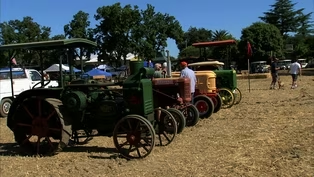
California Historic Tractors Take to the Field
Video has Closed Captions
It’s old-time harvest days in California…bringing in the crop with a 30-mule team hitch. (4m 33s)

Farm to Fork: Mini Zucchini Pies
Video has Closed Captions
On Farm to Fork, discover how to add some zing to your zucchini. (6m 58s)
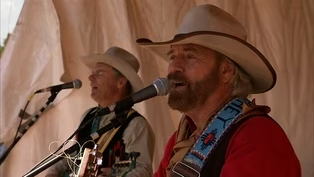
Michael Martin Murphey Salutes America's Farmers
Video has Closed Captions
Singer/songwriter Michael Martin Murphey takes to the stage to salute American agriculture. (4m 52s)
Providing Support for PBS.org
Learn Moreabout PBS online sponsorship
- Food
Christopher Kimball’s Milk Street Television
Transform home cooking with the editors of Christopher Kimball’s Milk Street Magazine.







Support for PBS provided by:
America's Heartland is presented by your local public television station.
Funding for America’s Heartland is provided by US Soy, Sustainable Agriculture Research and Education, Rural Development Partners, and a Specialty Crop Grant from the California Department of Food and Agriculture.