
GOP and Democratic strategists on where they expect to win
Clip: 10/7/2026 | 7m 27sVideo has Closed Captions
Republican and Democratic strategists on closing messages and where they expect to win
Republicans hold a massive financial advantage, but it’s Democrats making gains in the polls in the final month of the midterm elections cycle. To discuss each party's closing strategy, Amna Nawaz sat down with Democratic strategist Faiz Shakir and Republican strategist and media consultant Melik Abdul.
Problems playing video? | Closed Captioning Feedback
Problems playing video? | Closed Captioning Feedback
Major corporate funding for the PBS News Hour is provided by BDO, BNSF, Consumer Cellular, American Cruise Lines, and Raymond James. Funding for the PBS NewsHour Weekend is provided by...
GOP and Democratic strategists on where they expect to win
Clip: 10/7/2026 | 7m 27sVideo has Closed Captions
Republicans hold a massive financial advantage, but it’s Democrats making gains in the polls in the final month of the midterm elections cycle. To discuss each party's closing strategy, Amna Nawaz sat down with Democratic strategist Faiz Shakir and Republican strategist and media consultant Melik Abdul.
Problems playing video? | Closed Captioning Feedback
Where to Watch PBS News Hour
PBS News Hour is available to stream on pbs.org and the PBS app.
Providing Support for PBS.org
Learn Moreabout PBS online sponsorshipAMNA NAWAZ: Meanwhile, back in Washington, the midterms will decide whether Republicans retain complete control over Congress.
Here to discuss each party's closing strategy are Democratic strategist and senior adviser to Senator Bernie Sanders Faiz Shakir and Republican strategist and media consultant Melik Abdul.
Welcome to you both.
MELIK ABDUL, Republican Strategist: Thanks for having us.
AMNA NAWAZ: As we all know, polls are not predictive.
They capture a moment in time.
But the latest generic ballot polling average from Nate Silver shows a nearly 10-point lead for Democrats right now.
Melik, based on that, what is your assessment of where control of the house and Senate might end up?
MELIK ABDUL: Republicans are doing great.
(LAUGHTER) MELIK ABDUL: No, we're not.
So we're supposed to lose at least - - if you just gauge history, we're supposed to lose at least one or both of the houses.
It seems like the Democrats have a much better chance at winning the House than they do Senate.
I know there are some outlier races.
But I do think that if you talk to Republicans, our -- we're much more concerned about holding on to the Senate and kind of conceding that we very well may lose the House.
AMNA NAWAZ: You agree with that, Faiz?
FAIZ SHAKIR, Democratic Strategist: Yes, a few major things going here.
One is Democratic enthusiasm.
We saw in the primaries more Democrats voted than Republicans.
You can sense the Democrats want to run through a wall and ready to vote.
The question is whether Republicans are ready to run through a wall and a vote.
And generally you see a lack of enthusiasm on their side.
And that's helping us.
The biggest issue in this election cycle, which is also helping Democrats, is, do you want to check on Donald Trump?
That is the one uniting question and issue that all the Democrats could run on and say, put us in charge.
They have had the House and the Senate.
You want to change policies on tariffs, on Iran war, come with us.
AMNA NAWAZ: Do you see them winning control of the Senate, though?
FAIZ SHAKIR: Yes, I do.
AMNA NAWAZ: You do.
OK.
Melik, let me ask you about -- we're seeing Republican candidates right now on the campaign trail, because we have already seen some, like Florida Representative Maria Salazar, criticize the president's immigration policy.
We saw the Michigan Senate candidate there, Mike Rogers, call for an end to his tariff war.
We saw the Iowa Senate candidate break with him when it comes to the war in Iran.
They're criticizing him now on the campaign trail.
But if they win, would they continue to do so once in office?
MELIK ABDUL: It depends on where that is.
If it's someplace maybe like a Texas, maybe not.
But if you're looking somewhere -- let's say we do end up keeping -- winning Kansas or someplace like, that's why you're seeing Donald Trump go to certain places, where he at least has a base of support.
So he probably won't go to a place like Maine, but he will, even surprisingly, go into some place like New York, because he's a New Yorker in the Syracuse race, going to Syracuse for Blakeman.
So you will see those type of things happening, but Republicans are just really trying to hold on to the Senate and not knowing how to predict what the news cycle will be, because Donald Trump changes that by the hour.
AMNA NAWAZ: That is very true.
Faiz, Melik brings me right to you with some of the states he name-checked there, because there's some key Senate races there.
We're seeing in Kansas and Texas, it's definitely in play for the Democrats, Georgia, North Carolina, polls show Democrat candidates are now leading.
In Maine and Michigan, though, where you have more progressive candidates running, those races are still toss-ups.
Is all of that saying to you that moderate candidates are more electable in this sphere?
FAIZ SHAKIR: No, not necessarily.
I think what you're finding is a lot of these candidates speak to their geographies.
You look at a Troy Jackson, he's a Mainer.
You look at Mary Peltola, she's an Alaskan.
More than ever before, I feel good about the slate of candidates that Democrats are running.
And because you have Republicans disaffected, the possibilities of a Talarico, a Josh Turek, a Sherrod Brown, a Roy Cooper to win Republican votes is greater than it's ever been.
And it has less to do with ideology, the question that you asked me.
It has far more to do with, am I connected to your economic life and struggle?
Do you see in me someone who understands your life?
The candidates that I'm putting up, we're putting up together, whether you're Abdul, whether you're Troy, whether you're Roy Cooper, I think generally are winning on the basis of, I know your life.
And this guy, Trump, does not.
AMNA NAWAZ: Meanwhile, we have seen President Trump heading the campaign trail in Texas today.
But, Melik, as you referenced earlier, he's in a district that was gerrymandered around Latinos who already supported him in 2024.
And polls are showing that his Latino support in some of those places he did win in the previous cycle, that that support is softening.
Is there concern that coalition that he built is now crumbling?
MELIK ABDUL: I have written about it in "Newsweek" and The Washington Examiner talking about Trump's coalition, and it is an unknown thing.
The big thing for me to watch overall when you're talking about Texas is the Hispanic vote.
Donald Trump won the Hispanic vote maybe about 53 or 54 percent.
But I think that, if Paxton, for one, is under that 50 percent threshold, we lose the Senate.
But also what that Hispanic vote also has to look at what's happening in Florida.
I think that the Hispanic vote is going to be the gauge, not just for 2026, for 2028 as well.
If there is a loss of support among Hispanics for Donald Trump, we're going to have a rough night.
AMNA NAWAZ: What should be the strongest economic message for Republican candidates right now, though, knowing what they're up against, which is high inflation, prices still rising?
MELIK ABDUL: I think that it could kind of piggyback off of what you said.
They have to localize the race, because the opponent -- the opposition will actually nationalize it.
So the things about gas prices and all of those things that these state and local candidates can't do anything about, they have to talk about what we saw in the debate in Georgia.
They have to talk about the data centers.
They have to talk about trying to do things locally, lowering the tax rates.
In Florida, insurance is a big issue.
They have to talk about local issues, because Donald Trump and those national issues will definitely suck all of the oxygen out of the room.
AMNA NAWAZ: Faiz, some of those voters aren't necessarily going for Dems.
They're going against Trump.
So what do Dems need to do or say to keep them beyond '26?
FAIZ SHAKIR: Well, it is helping that Donald Trump is saying that we're in a golden age, that we're living in some kind of sense that everything is gangbusters, this thing is amazing.
And yet he owns this economy.
When you think of DOGE and you think of tariffs and you think of the Iran war, these are choices made politically that have affected the economic lives of many people.
Now, when you're saying I see, Amna, and you're questioning the opportunity for massive political coalition building for Democrats out of this.
When I look at on election night and we're watching the results, I'm wondering how rural voters will vote, because they have been suffering many of the things I just mentioned, diesel.
And the economic plights against farmers have really affected them.
Now, if rural voters come off of Donald Trump, the places that we're talking about, Nebraska, Ohio, you go down the whole -- Texas, all these has -- puts them into play, but not only puts them into play for this cycle, puts them in play for the possibility of future Democrats who want to build a broader, more expansive working-class party.
AMNA NAWAZ: I have 30 seconds left.
I got to ask each of you, on election night, is there a single race you're watching that could be an early indication of how the rest of the night will go?
Melik, do you have one?
MELIK ABDUL: I will say Maine.
AMNA NAWAZ: Maine.
MELIK ABDUL: Maine.
FAIZ SHAKIR: I'm interested in Florida, I mean, for a lot of the reasons, just Mar-a-Lago.
And we will see if the Trump effect works there.
But I'm interested in -- Angie Nixon is running for Senate, and I think there's a chance of David Jolly being the governor.
It comes in early.
I believe that you will see the disaffection of Republicans happen or not in Florida.
AMNA NAWAZ: Faiz Shakir, Melik Abdul, great to have you both here.
Thank you so much.
MELIK ABDUL: Thank you.
FAIZ SHAKIR: Thank you.
Good to see you.
 New
NewEvidence suggests GLP-1s can curb drug and alcohol cravings
Video has Closed Captions
The evidence suggesting GLP-1s can curb drug and alcohol cravings (10m 36s)
 New
NewGeorgia governor's debate highlights voters' top concerns
Video has Closed Captions
Georgia governor's debate highlights voters' top concerns (3m 55s)
 New
NewIsraeli and Palestinian fathers partner to bridge divides
Video has Closed Captions
Israeli and Palestinian fathers partner to bridge divides 3 years after Oct. 7 (8m 25s)
 New
NewNews Wrap: Lawyer says Christa Pike 'angry and confused'
Video has Closed Captions
News Wrap: Lawyer says Christa Pike 'angry and confused' following botched execution (5m 31s)
 New
NewOct. 7 survivor channels trauma into leadership movement
Video has Closed Captions
Oct. 7 survivor channels trauma into movement for new generation of Israeli leaders (4m 44s)
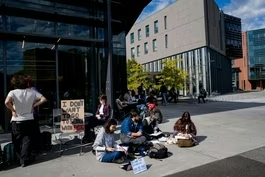 New
NewWhat Cornell case reveals about handling of rape allegations
Video has Closed Captions
What the Cornell case reveals about how sexual assault allegations are handled (6m 45s)
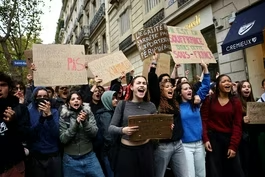 New
NewWhy French students are flooding the streets in protest
Video has Closed Captions
Why French students are leading massive protests across the country (4m 5s)
Providing Support for PBS.org
Learn Moreabout PBS online sponsorship New Episode
- News and Public Affairs

Today's top journalists discuss Washington's current political events and public affairs.

- News and Public Affairs

FRONTLINE is investigative journalism that questions, explains and changes our world.
 New Episode

 New Episode
 New Episode
 New Episode

 New Episode
 New Episode
 New Episode
Support for PBS provided by:
Major corporate funding for the PBS News Hour is provided by BDO, BNSF, Consumer Cellular, American Cruise Lines, and Raymond James. Funding for the PBS NewsHour Weekend is provided by...