Virginia Home Grown
Hillside Farm
Clip: Season 26 Episode 5 | 8m 16sVideo has Closed Captions
Visit a farm in a public housing community providing fresh food and leadership training
Shana Williams visits Hillside Farm in Richmond to learn about the positive impact Groundwork RVA is cultivating in a public housing community with Katie Carline and Nathan Burrell. Featured on VHG episode 2605, July 2026.
Problems playing video? | Closed Captioning Feedback
Problems playing video? | Closed Captioning Feedback
Virginia Home Grown is a local public television program presented by VPM
Virginia Home Grown
Hillside Farm
Clip: Season 26 Episode 5 | 8m 16sVideo has Closed Captions
Shana Williams visits Hillside Farm in Richmond to learn about the positive impact Groundwork RVA is cultivating in a public housing community with Katie Carline and Nathan Burrell. Featured on VHG episode 2605, July 2026.
Problems playing video? | Closed Captioning Feedback
Where to Watch Virginia Home Grown
Virginia Home Grown is available to stream on pbs.org and the PBS app.
Providing Support for PBS.org
Learn Moreabout PBS online sponsorship>>I noticed that many of your rows are segmented instead of one particular crop.
>>I do that for a few different reasons.
One, it's really easy for volunteers to plant in our garden on large planting days.
A lot of them are youth, so I don't wanna overly complicate things.
And I've also learned through practice that diversity is key in a production bed.
So I want to promote more companion planting.
The squash, I want something to grow around it to support it.
And so we really are planting three different plants in one area, like conventionally that you would normally do.
>>And then when you're transplanting things out, you can just simply plug in something in the bare spots.
>>Yes, there's always three different seasons in one area.
>>I noticed that you have cucumber melons growing up also.
>>Yeah, we like to highlight some rare or uncommon veggie cultivars here, and it gives youth an opportunity to try out different vegetables that they haven't tried before.
So we have a couple different cultivars of like a red okra, and we have different corn that we're growing seasonally, and it's fun to just try different things that you don't even see in the grocery stores.
>>I like the kale, the collard greens.
I like the cucumbers.
I like squash.
The key herb out here that I like that can help me with my health is the rosemary.
It's for my lungs, for my congestion.
It's good for me because I am on oxygen, and I like the mullein tea too.
>>We are a Black and brown youth-led environmental organization that focuses on environmental change in the communities that our youth come from.
We have a urban farm here in Hillside Court, one of our legacy housing communities in South Richmond, where we do everything from providing fresh fruits and vegetables to the community for free, to camps for kids, to farm teams of hiring youth directly from the community that are working here in the farm, direct community empowerment.
The vision for this space is truly to build out a space as the true community resource that it is.
The opportunity to sit under 100-year-old oak trees, commune with nature, just calm down a bit when life is just really stressing you, spaces that you can get food, just enjoy your community, that's the value that this space really provides.
>>While you might think that, oh, a beet is just a vegetable, it's actually really good for your heart health and your blood pressure.
So everything that's in here has five different uses.
You can use it, you know, for sensory to, like, calm you down, to chill you out.
You can eat it to help your blood pressure or your cholesterol.
A lot of these veggies help with diabetes, which is an epidemic in the area as well.
>>You have some celery.
You have some of your cabbage and other things.
Do you have to deal with any of the insects that, you know, especially that harlequin beetle that seems to wipe out mine?
>>I know.
>>I don't seem to see very many.
>>I don't wanna jinx myself.
We are pretty good on the pest management.
We're no spray, no till.
I don't know if it's the birds or just like as a whole, everything's really taking care of itself in this garden.
>>Well, you seem to be doing a fantastic job.
I see over in the distance you have a fruit orchard.
Tell me about that.
>>Yeah, so we have 75 fruit trees all planted over in the area here.
We get fruits from April all the way to October, ranging from pears, plums, peaches, apricots, figs.
We have a ton of apples, and everyone really loves to come over and harvest the fruits.
It's the best they've had.
They're really expensive in the grocery store, which isn't even around here.
But people can come in and harvest, like, some really delicious-tasting fruits that they wouldn't normally get to.
>>Yes, especially in the stores, they've already harvest everything before it's really ripened, so they're really getting a chance to taste some fresh food.
>>Yes, right off the tree, it's the best you'll have.
>>Definitely.
(both laugh) Now, Katie, this is a large area here, an acre and a half, I believe.
I know that you're not just managing this all on your own.
Please tell me how the youth are connecting and helping you maintain this garden.
>>So it is, a lot of it is me, but I will say our elementary-aged youth are some of the best workers I've had.
I call them my sprouts team.
They'll come out and be like, "Oh, we saw your car," and they'll run over and be like, "What are we doing today?"
So usually they're watering, which is a big help, but they love to weed and plant.
They'll come through.
They've made all my signage.
They're really willing to do whatever needs to be done here and get their hands dirty.
And they have like a sense of empowerment too.
They walk around and say, "I did that."
"I helped with that."
"I grew that."
So it's like pretty cool for them too to take ownership.
We also have a high school green team that has planted our bioswale, and they come through and do a lot of our environmental justice data collection.
And so they take this on as their yearly project, and it's very impactful positively like with the environment, socially, economically.
It does a lot.
>>Someone mentioned earlier that sometimes you gotta take a busload of 'em, and you do field trips places.
>>Yes, that is like a plus side.
I get to do some fun field trips, not all just farming.
So it's really hot here in Hillside.
I'm able to take our work vehicles, and we'll go to Taylor Farms Park, a splash pad.
We'll go to the river.
We're going rafting in a couple of weeks.
Yeah, so it's like they get the fun stuff and the hard stuff.
>>I love how the garden has so many varieties of vegetables.
Can the community come in when they just need something to supplement that meal and just harvest whenever they want?
>>This is their space.
I'm here throughout the whole day, but they'll come in and ask me, you know, what certain things are, how to harvest things.
We'll work on harvesting stuff together, but I really want them to feel autonomous in being able to take ownership of the space.
So people will come walk by during the day and say, "Oh, I harvested all that kale, all those veggies.
I made some soup last night."
And that just like makes me feel so good about it.
>>I can imagine it would.
>>So I'm just like, "Keep doing it."
(laughs) >>Yeah, that's great.
Now I need to know, how did you get them involved on a regular basis to wanna come out here?
>>It took some time.
It took a lot of trust building.
A lot of organizations come into environments like this and don't fully commit to what their mission and what they're doing.
I love the physical work of this, so I'm here every day.
And I think it took a lot of trust building with the community members, me showing up every day, and they know that they can trust me.
And so we'll like work together every day and, like, come together and do stuff.
>>I like the garden.
It's pretty.
And I love how Katie work with us, and we'll play games, play tag, play hide-and-go-seek and stuff in the garden.
It's lots of places you can hide at in the garden.
>>Tell me about your expansion plans for this particular site.
>>Our green team worked with the science museum, and they built us a cold frame so that we can eventually start growing things in the winter, start putting things in the ground earlier in the year, and making it to where we can have four seasons of crop production.
So I think it would engage the youth more as well.
>>You're doing a great job of empowering people.
>>Thank you.
>>Thank you, Katie, for everything that you're doing.
>>Our vision is to be able to not only duplicate this in other RHA communities.
We're working right now with RHA to renew our lease here for Hillside Court.
And we're looking at opportunities in Witcomb Court and a few other housing communities here in the city of Richmond as well.
Spaces to be able to cool off, spaces to be able to recreate, is paramount for communities like this.
And we're happy to be engaged as a part of that team that's helping to make that happen.
>>I always tell her what's going on, what the people come out here and what they like to pick and take home.
And I tell her what's not growing good and what is growing good and what's tasting good and what's not tasting good.
And this is our garden.
(laughs)
 New
NewVideo has Closed Captions
Clip: S26 Ep5 | 6m 41s | Discover vegetable pairings to grow in your garden for a healthy and bountiful harvest (6m 41s)
 New
NewVideo has Closed Captions
Clip: S26 Ep5 | 7m 50s | Tour a garden at a rural hospital focused on improving food security and community health (7m 50s)
 New
NewVideo has Closed Captions
Clip: S26 Ep5 | 5m 39s | Relax with a refreshing herb infused beverage after a day in the garden (5m 39s)
 New
NewVideo has Closed Captions
Clip: S26 Ep5 | 4m 14s | Create a container full of tomatoes and herbs to top homemade pizzas (4m 14s)
 New
NewVideo has Closed Captions
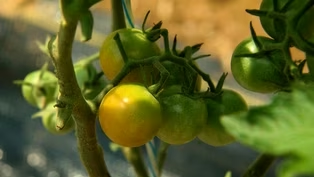
Clip: S26 Ep5 | 3m 33s | Learn why high heat slows tomato pollination (3m 33s)
Providing Support for PBS.org
Learn Moreabout PBS online sponsorship

- Home and How To

Hit the road in a classic car for a tour through Great Britain with two antiques experts.
 New Episode





 New Episode




Support for PBS provided by:
Virginia Home Grown is a local public television program presented by VPM